
Suburban, online retail overtakes malls
Celebrating 30 years of Northern Colorado Business Report and BizWest business coverage
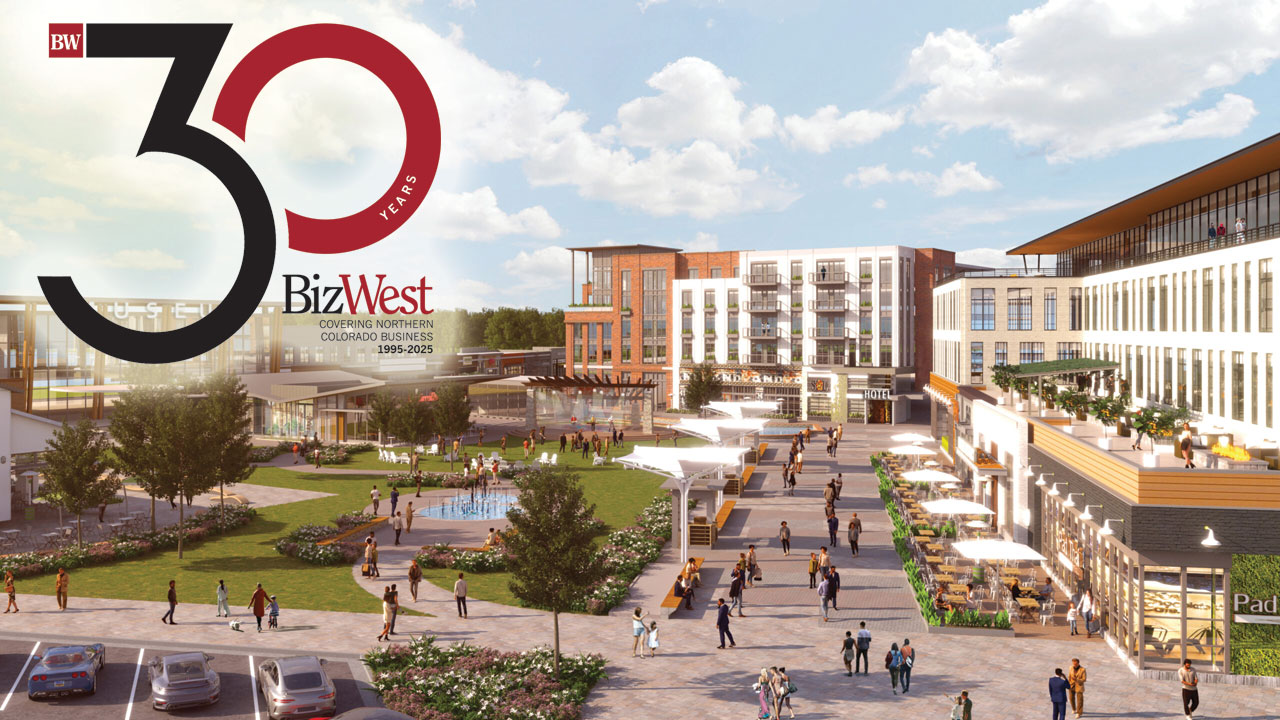
Online shopping and the COVID-19 pandemic continued to upend traditional shopping habits in recent years, with creative retailers trying to offer ever more experiences to draw shoppers to open their wallets.
At the same time, downtown shopping districts have enjoyed a resurgence in interest in places as diverse as Fort Collins, Greeley, Johnstown and Eaton as communities focus on offering up activities that can drive more sales-tax revenue.
The last three decades of retail in Northern Colorado has been one of rapid change, including new investment.
For example, Greeley officials have teamed up with a private real estate firm with ambitious plans for $200 million in public and private development that include a new hotel and apartments downtown, which could stimulate additional retail demand.
Johnstown officials recently created a branding campaign and made plans to expand the main downtown core, possibly adding a future parking garage as amenities for new housing planned nearby.
In Eaton, some business owners are broadening their investments to fixing up historic buildings and new breakfast restaurants as the town looks toward a possible new downtown development authority.
Fort Collins Old Town retailers are discussing paid parking as a plan to keep more spaces open and turning over more quickly, while Loveland spends $24.5 million for its Heart Improvement Plan in the community core.
Other retail developments have continued apace in recent years along busy road corridors, many of them incorporating new homes as well.
Ladera — emerging at the southeast corner of Harmony Road and Interstate 25 in Timnath — is expected to include a mix of retail, restaurants, entertainment, fitness, hospitality, office space and homes. The development is expected to generate an estimated $218 million in sales and property tax for Timnath over the next 25 years, according to development company Connell LLC.
At the Interstate 25 and U.S. Highway 34 interchange, the Loveland City Council approved annexing Schmer Farm, which is expected to lead to a 30-acre commercial development, possibly including a King Soopers and gas station. The 140-acre Centerra South nearby has been mired in controversy, but is expected to cost more than $1 billion and include retailers such as a Whole Foods grocery store, offices, restaurants and hospitality uses, according to project developer McWhinney Real Estate Services Inc.
The 2534 development is on the southeast corner of the interchange, a 600-acre community of retailers and restaurants, including a Scheels store.
Buc-ee’s opened on the southwest corner of the Interstate 25 and Colorado Highway 60 interchange in Johnstown in 2024, causing a $1 million sales tax revenue jump in its first year of operation. And a Target Corp. (NYSE: TGT) store is expected to open in 2026 at the southeast corner of the Interstate 25 and Colorado Highway 119 interchange, joining other big box retailers Home Depot Inc. (NYSE: HD) and American Furniture Warehouse among several other retailers, car dealers and restaurants nearby.
Going back 30 years, indoor malls used to rule the Front Range, with Crossroads Mall in Boulder, Twin Peaks Mall in Longmont, Foothills Fashion Mall in Fort Collins and Greeley Mall the best places to shop.
As a result, some other communities in Northern Colorado did not have the retail wherewithal to compete. So if men were hard pressed to find a store where they could buy a business suit in Loveland 25 years ago, Loveland City Council and chamber of commerce bemoaned “retail leakage,” the term applied when residents of one town would go to another town to buy retail goods. With those residents went both the spending that would otherwise support jobs in the home community and the sales taxes that financed local governments.
That began to change in the early part of the new century across the country and close to home in Northern Colorado.
At Interstate 25 and U.S. Highway 34, McWhinney began developing multiple corners of the interchange. In 2004, brothers Chad and Troy McWhinney signed a master financing agreement with the city of Loveland that enabled them to use metropolitan districts to develop about 3,000 acres of land with offices, homes, industrial buildings, warehouses and, of course, retail stores.
The new retail changed the sales-tax picture in Loveland significantly. It also changed shopping patterns in Northern Colorado and prompted the slow decline of indoor shopping malls.
But an even bigger change was starting to grip retailing 25 years ago – the online shopping phenomenon that upended how consumers think about shopping.
Michael Aldrich of the United Kingdom is credited with the first online sale in 1979. But it would be 15 more years before the online sales industry really took off. Home shopping networks, such as QVC, exploited cable television, but true online sales began in earnest in 1994 when Amazon.com sold its first book. Then eBay began in 1995.
Amazon went public with an initial public offering in 1997, and local, brick-and-mortar retailers have been losing market share and their relationships with customers ever since.
Online sales crept up to about 10% of all retail sales at the end of 2018. By the beginning of 2020, online retailers had 11% of the market. By the end of the second quarter of 2020, due to stay-at-home orders, online sales spiked to 16.1%.
The wave of redevelopments toward outdoor or lifestyle malls began in earnest 20 years ago. Crossroads Mall in Boulder was knocked down to make way for Twenty Ninth Street; FlatIron Crossing in Broomfield started redeveloping in earnest in 2023.
Stenn Parton, a retail expert with DJM Real Estate LLC, a California-based company, told BizWest 10 years ago that COVID would drive shoppers to outdoor venues that feature patio dining and stores with smaller footprints.
Developers will find, he said, that mixed-use shopping districts are likely to have the best success. Such centers will feature retail, along with entertainment, dining, recreation and offices. His words turned out to be correct.
“Perhaps you could convert department stores to offices, bring in multi-family [residential units], or hospitality,” Parton said.
Parton said one likely evolution of retail centers could help bridge the gap between e-commerce players such as Amazon and brick-and-mortar operators.
“Regional malls are tremendous locations for last-mile distribution,” he said. Increasingly, online shoppers may order goods from Amazon only to have those orders delivered from distribution centers located within the same department stores Amazon helped put out of business.
The engines of retailing from 25 years ago continue searching for their niche in the marketplace.
Foothills Fashion Mall, which opened in 1972, was redeveloped in recent years, but its performance has been about a third of what the city projected when it poured $53 million into an incentive package. McWhinney Real Estate Services Inc. said in 2023 it would include more mixed-use, including housing, in its redevelopment mix.
The Greeley Mall opened in 1973 and was renovated in 2004. It has lost anchors and currently generates a fraction of the sales tax that it raised during its heyday.
The Promenade Shops at Centerra in Loveland, one of multiple retail centers that are part of the 3,000-acre Centerra development in east Loveland, continues to be a sales tax generator for the community although like malls across the country has faced headwinds from internet sales that have driven previously reliable brick-and-mortar stores out of business. Galway Cos. bought the shopping complex in August.
Updated from November 2020, with additional reporting by Lucas High and Dallas Heltzell.
See more 30th Anniversary stories.
Wood: Fond memories of folding chairs in an attic
30 years that remade Northern Colorado
Suburban, online retail overtakes malls
A picture in time: Kodak’s rise and fall in Windsor
Hewlett-Packard: A tale of three cities
Can Colorado’s beer scene craft a comeback?
Weld County continues to dominate state’s oil and gas scene

Related Posts
-

DENVER — Colorado bankruptcy filings increased 12% in July compared with the prior year, continuing…
-

Colorado’s seasonally adjusted unemployment rate was 4.8% in May, flat from the previous month, according…
-
Colorado bankruptcy filings increased 11.3% last year, but December filings jumped by 28% compared with…
-

Weld County’s economy grew at a 6.5% rate in 2024, seventh-best in Colorado.
