
CEOs on AI: ‘This is going to change everything’
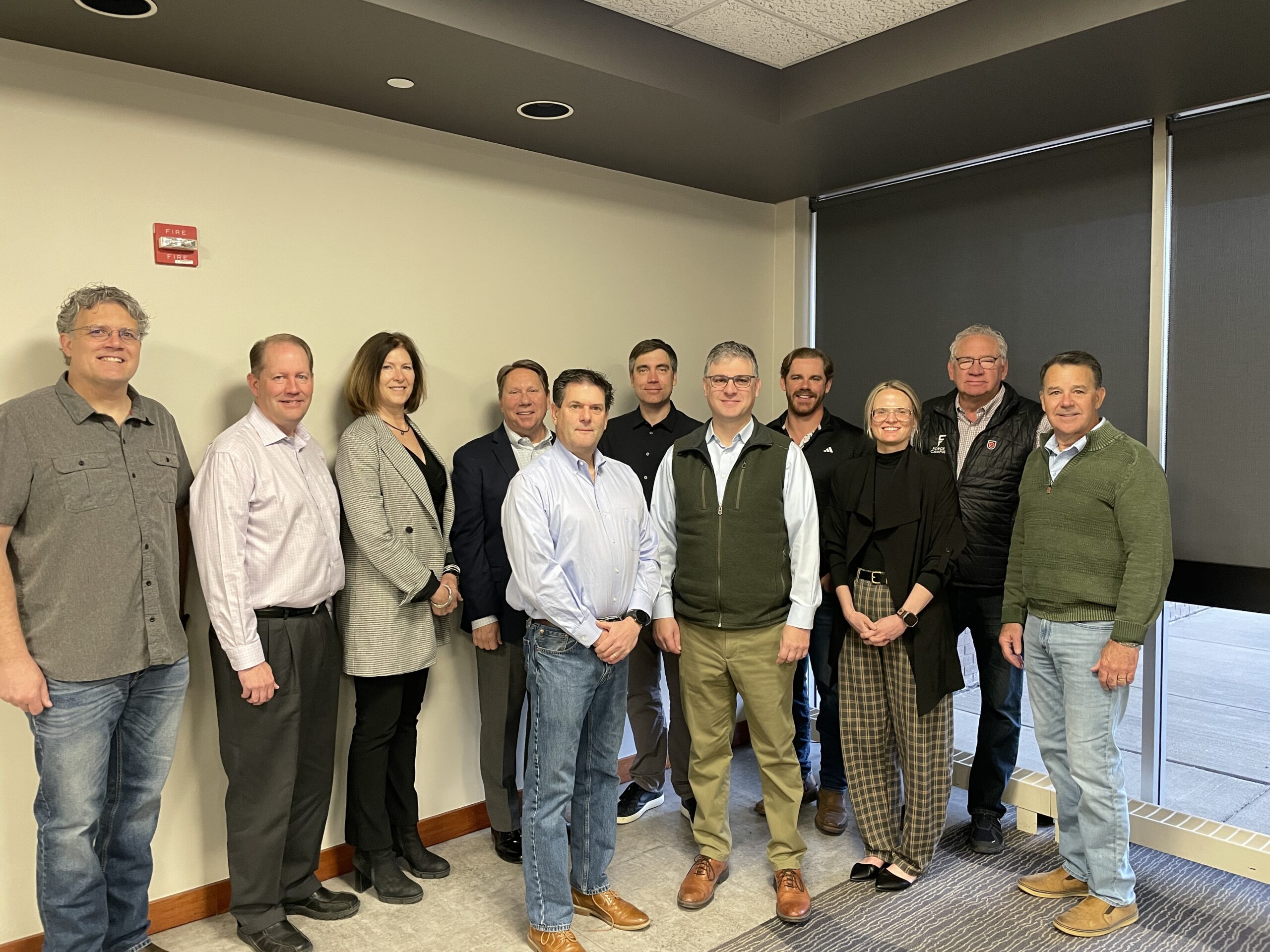
LOVELAND — From education to research and production, executives attending a BizWest CEO Roundtable on innovation this week agreed that artificial intelligence has turned their worlds upside down.
“I have gone in the last 12, 15 months from, ‘Eh, it’s not quite ready yet,’ to, ‘This is actually a pretty useful tool,’ to, ‘This is going to change everything,’” said Jim Bilodeau, CEO of Voestalpine Signaling USA LLC in Loveland. “I’m sitting in my office and, I swear to God, I can write code to replace two developers like they were sitting next to me. It’s staggering to me what that thing can put out.”
Added Blake Craig, CEO of Fort Collins-based Laborjack, “We’ve seen the transition go from just a tool to increase small efficiencies to really taking over and, in many ways, supplementing our original workforce.”
When Craig called his chief technology officer to ask, ‘How much more productive are you now than four years ago,’ the CTO responded that, “without question,” his output had increased tenfold.
“We use AI in our robotic training and its vision technology to locate spot welds,” said David Burks, CEO of Progenero Products LLC, a Loveland-based company that does business as Insight Ultrasonics. “We capture a lot of ultrasonic imaging data, so we’ve developed machine-learning software that can look at that imaging and predict a failure model. So we can be testing a process and see when the process begins to drift. Then we can intervene before they start making bad parts.”
At Vergent Products at The Forge campus in Loveland, president and CEO Jay Dokter said “we’ve used it for a couple years now for supply-chain management. We manage hundreds of thousands of parts, individual part numbers and components, and it’s incredibly helpful to know supply and demand and best pricing.
“We use it to help quote projects, and it goes a lot faster,” Dokter said. “We also use AI for inspection. Some of our senior professional inspectors are retiring here soon, so we need to find a solution to replace those capabilities. So we’re investing a lot in cameras, visual-type inspections on our production line.”
He also said AI helped him find the best campground – and even the best campsite at that campground – when he and his wife vacationed to Glacier National Park.
“It doesn’t always get you there, though,” Dokter cautioned. “I did catch ChatGPT making a mistake. I said ‘You made a mistake!’ and it said ‘Yeah, you’re right. I’m sorry.’”
It’s not perfect, agreed Larry Myers, an attorney at Boulder law firm Berg Hill Greenleaf Ruscitti, one of the Roundtable sponsors along with Elevations Credit Union and accounting firm Plante Moran.
“The thing that scares me about it is that people are so wowed by what AI does 90% of the time that they forget that 10% of the time it’s going to totally fabricate something to make them happy,” Myers said. “At some point people stop checking because they get good result after good result after good result.
“What gives me confidence, though, is that no human will ever want to be sentenced by a robot. No human will ever want their divorce decree to be finalized by a robot,” he said. “It can’t replace a lawyer with years of experience.”
Nathan Gray, co-founder of Johnstown-based MeshComm Engineering, echoed AI’s time-saving benefit.
“We’ve probably accomplished through the first three months of this year what it would have taken us the entire year last year to accomplish,” he said. “That’s how much faster we’re moving as a team right now.
“I used to write code every single day until about four or five months ago,” Gray said. “I haven’t written a lick of code in five months. What I can accomplish now in six hours would have taken me three to five weeks previously.”
“Where we’ve seen huge gains,” Craig added, “is, rather than ‘Hey, help me with my ideation,’ it’s, ‘Hey, write this piece of code for me.’ Everybody’s leveraging it.
“And personally I’m using it at a business partner level, turning out conversations and turning out documents, and being able to get proposals written in a fraction of the time,” he said. “Now we don’t need the fundraising environment to grow. This is faster and cheaper.”
Gray noted that outside of work, AI also serves as a personal tutor to his daughter as she tackles her calculus homework.
“It’s an interesting time to be in education,” agreed Janel Highfill, associate vice president for workforce development and strategic partnerships at Front Range Community College, “because we’re looking at AI as a foundational skill. It’s like problem solving and communication. People have got to understand it and be thoughtful about how to use it.
“The future for technicians is still great,” Highfill said, “but what we are shifting to is that all of our students need to understand AI: what it can do, what it can’t, how it demands higher-order thinking, critical thinking, analytical thinking. And that is a process.”
It might be easy for a student to use AI to pump out a term paper, she said, “but when an instructor sees five papers that are virtually the same because people have just used AI because it’s easy to produce, it ends up being a good learning experience because you can’t go out into industry and get away with that.”
Bilodeau, however, countered that “you actually can go out into industry and get away with that. You can pump out a paper and maybe it’s not 100% correct; it could be 90% but that’s your task and you got it done.
“Some of the rigor is much more intense at the university level of what goes into producing that product than it necessarily is in industry,” he said.
But Highfill held her ground. “You can’t just do it blithely,” she said. “You’ve got to think about it. They can use AI, but the future is for those who choose to edit it.”
Educating new technicians in an AI-dominated world has been clouded by cuts and suspensions of federal grant programs, said Richard Magid, Colorado State University’s vice president for technology-transfer programs.
His big question is whether there will be research funding to train the next generation of scientists and engineers.
“The overall hit to CSU last year was less than 10%, but more is coming down the pike,” he said. “The whole mechanism has slowed down. If you look at the Congress-appropriated money for (National Institutes of Health) grants for health research, the pace of grants going out the door, it’s way down. There’s been appropriated money, but they’re not actually pushing it out. And those grants are what pay for people and equipment and supplies.
“That’s how the science actually gets done,” Magid said. “If the money’s sitting in D.C. and not making it out to the end of the funnel, it’s not really doing anything to advance science or to train that next generation.”
When the technology-transfer systems at such schools as CSU and the University of Colorado Boulder spin off an ambitious startup, in recent years their research and development efforts have been given a boost by the Small Business Innovation Research program designed by the U.S. Small Business Administration or the Small Business Technology Transfer program offered by nearly a dozen federal agencies.
But not lately, Magid said.
“SBIR and STTR, those programs have been broken.” he said. “It hasn’t been funded at all. Maybe the House will push through, finally, a reauthorization of those programs, but no small business has been able to get those for the past year. A lot of times, that’s the first nondiluted capital a startup uses to get the flywheel going, to get positioned to go and raise capital. Without those programs, it has been a challenge.”
Added Gray, “We have not really worked with the SBIR and STTR programs, but some of our customers have, so the slowdown’s effects to those grant programs have definitely caused our customers to put on hold projects for a period of time.
“We actually just started working with a grant one of our customers received 18 months ago, and then everything was put on hold,” he said. “It’s been kind of a start-stop-start-stop thing. So it definitely has had an impact, although probably not as drastic as some other companies.”
As if startups needed another steep hill to climb, Burks said.
“Most startups will tell you it’s a daunting thing, basically, just networking,” he said. “Making connections takes a lot of time and energy. That’s one of the key struggles we’re going through right now is just making the right connections so you can get introduced to the right people and leverage those relationships.
“You have to be able to demonstrate some scalability into some interesting markets” to get venture capitalists’ attention, Burks said.
Bilodeau said students in colleges now have some hard choices to make because the influence of artificial intelligence is going to create “a lot of flux in the software field.
“An entry-level developer coming out of a university has to think long and hard,” he said. “The job they might have had going into that program four years ago is going to be completely different now. How are they going to grapple with that?
“I’m not saying they’re going to be out of a job; I just think it’s going to change,” Bilodeau said. “The opportunities are going to be different. We’ll need people to wield AI in ways to make it useful, and that’s what’s going to be exponential.”
They’ll have to address the security concerns being created by the use of AI, he said.
“Humans still need to be involved, but that’s even rapidly evolving,” he said. “Nobody knows where this goes. Some of it is a little scary, to be honest, because there will be stuff out there that it’s doing and nobody knows what it’s doing.
“It’s going to be a double-edged sword,” Bilodeau said, “and how that all sorts out is going to be honestly fascinating.”
With all its potential problems, however, he said, AI is worth it.
“We’re using it all over the place,” he said. “I don’t think we even have scratched the surface of where we could use it. I can say, ‘Hey, give me a tool that tells me this, and boom, there it is. That would have been two weeks with a good developer.
“We haven’t come to grips with how this is going to change things,” Bilodeau said. “It’s a tiger by the tail.”
Also attending the Roundtable were representatives of its sponsors: Ashley Legan of Berg Hill Greenleaf Ruscitti, Mike Grell of accounting firm Plante Moran, and Dennis Paul of Elevations Credit Union.
From education to research and production, executives attending a BizWest CEO Roundtable on innovation this week agreed that artificial intelligence has turned their worlds upside down.

Related Posts
-

LOUISVILLE — Aerospace manufacturer Sierra Space Corp. and NASA have entered an information, research and…
-

Kiosk Information Systems Inc. plans to move from its longtime headquarters on South Arthur Avenue…
-

BOULDER — VitriVax Inc., a Boulder-based developer of vaccine-shot technology, was recently awarded a five…
-

Ambrosia Biosciences has closed an $100 million Series B round to fund clinical trials of…
