
Infleqtion consolidating at expanded Louisville HQ
Quantum spinout from CU was born in Boulder
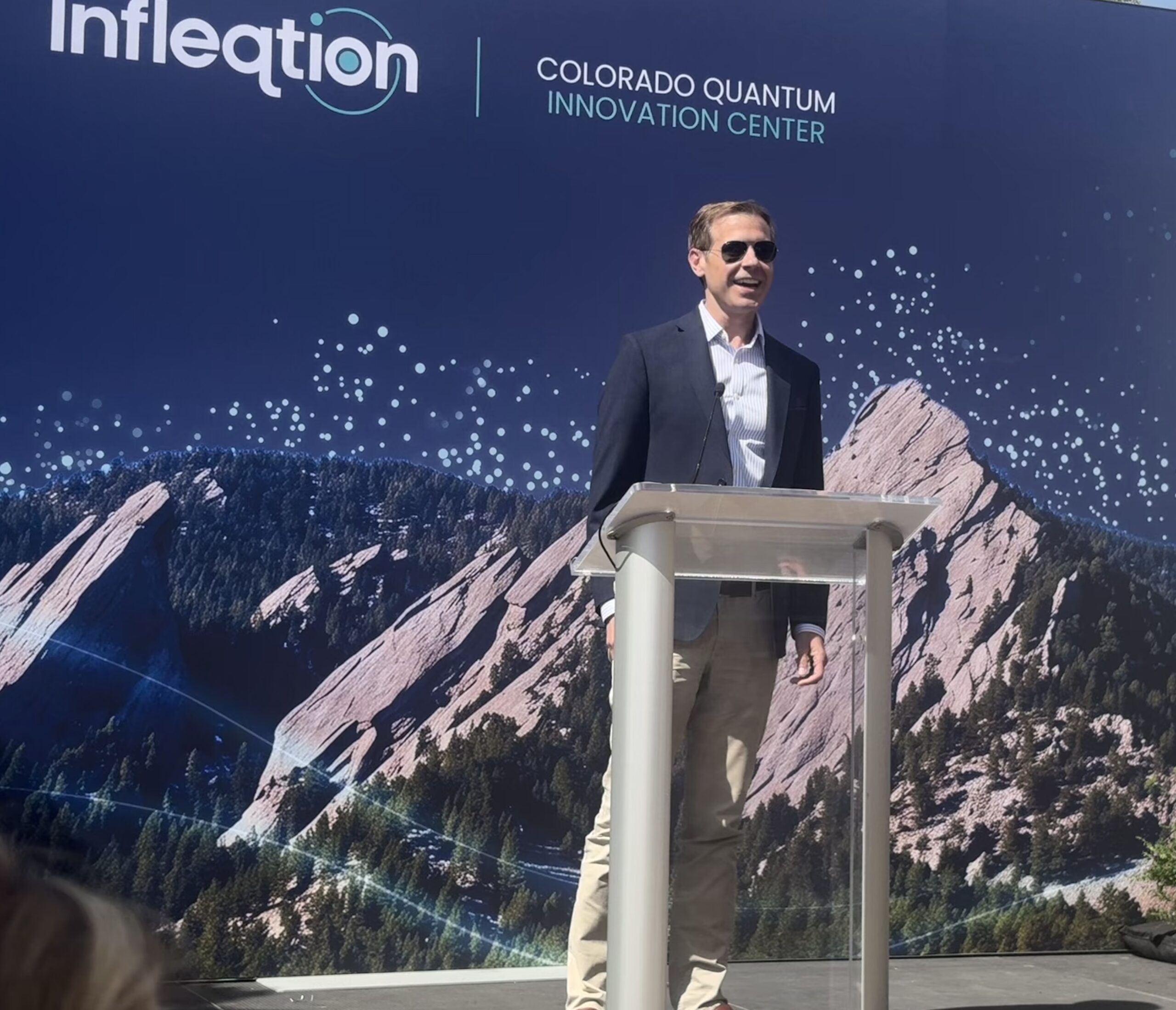
LOUISVILLE — Infleqtion Inc. (NYSE: INFQ), a Boulder-born quantum-technology firm spun out of the University of Colorado, is consolidating its Centennial State operations at its new Louisville headquarters, dubbed the Colorado Quantum Innovation Center.
The firm for the past few years has operated out of about 20,000 square feet on West Century Drive in Louisville, the primary home of Infleqtion’s Tiqker quantum-timekeeping technology, and about the same amount of space on Sterling Circle in Boulder, which housed the company’s quantum computer.
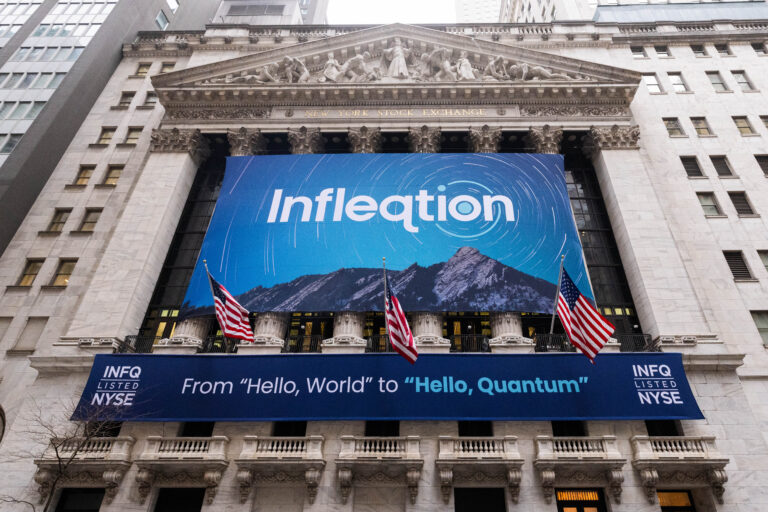
Infleqtion, which went public in February through a special purpose acquisition company merger, is giving up the Boulder space and has added about 80,000 square feet at 1315 W. Century Drive, where the company now occupies the entire roughly 107,000-square-foot building. About 100 workers at the Boulder facility will transfer to the Louisville headquarters over the coming months.
“We used to have two offices here — one in Boulder and the other in the easternmost 10% of this building” on West Century Drive, a space that was previously home to healthcare software firm Global Healthcare Exchange Inc., Infleqtion CEO Matthew Kinsella said Tuesday during a Colorado Quantum Innovation Center ribbon-cutting ceremony.
“Even though those offices were a 15-minute drive apart, in many ways it felt like a world apart,” Kinsella said. “What we were able to do is consolidate those two offices into just this one space. We really lucked out that the prior tenant of this building decided to leave, so we were able to take the whole thing over and unite the clans.”
GHX began downsizing at the Louisville offices in 2023, giving up about 86,000 square feet of space as more local employees became hybrid workers and the soft-ware-as-a-service firm expanded operations in India, according to the Denver Business Journal.
Infleqtion, which last fall claimed a $1.8 billion valuation and received $550 million in gross proceeds from its February SPAC merger and go-public activities, uses neutral-atom technology to build quantum computers, quantum clocks, RF receivers and inertial sensors.

Because neutral atoms don’t have a positive or negative charge, the company claims, they can be bundled together more densely than charged particles and arranged in ways that make Infleqtion’s quantum hardware more scalable than existing supercomputer technology.
Originally called ColdQuanta Inc., Infleqtion’s underlying technology was developed in University of Colorado labs by physicist Dana Andersdon, now an Infleqtion executive, CU professor and JILA fellow.
CU Chancellor Justin Schwartz called Infleqtion “one of CU Boulder’s most successful startups.”
Infleqtion, raised a $100 million Series C round last summer. The company hired Kinsella in 2024, a few months prior to raising more than $10 million from investors. Infleqtion — which, as of late last year, had more than 200 employees across the organization, roughly half of which are in Colorado — had previously raised a $110 million Series B round in 2022 to jumpstart commercialization of its technology.
Quantum theory attempts to explain the behavior of matter at atomic and subatomic levels. Because quantum computers take advantage of special properties of quantum systems such as superposition, their computing power and speed are exponentially greater than a traditional computer.
The Boulder Valley — with the University of Colorado Boulder physics department, the National Institute of Standards and Technology and JILA (formerly known as the Joint Institute for Laboratory Astrophysics) — has become one the world’s epicenters of quantum research over the past few decades.
The roots of the quantum industry “stretch back more than 60 years on the CU Boulder campus,” Schwartz said, pegging the birth of the sector to the 1962 establishment of JILA.
“Today really is about Colorado,” Kinsella said at Tuesday’s Infleqtion headquarters celebration. “Specifically, it’s about Colorado continuing to solidify its position as the global hub for quantum innovation. That is why we are calling our facility the Colorado Quantum Innovation Center. It’s not (called) the Infleqtion headquarters, it’s the Colorado Quantum Innovation Center.”
The local quantum ecosystem got a major shot in the arm in 2024 when the U.S. Department of Commerce’s Tech Hub program granted Elevate Quantum, a nonprofit consortium of about 100 stakeholders who represent industry, academia, capital and laboratories in Colorado and New Mexico, a Phase 2 Tech Hub designation that unlocked $127 million in state and federal funds, which are expected to generate several billion more dollars of private investment in the region’s quantum industry.
“Elevate Quantum exists to dramatically accelerate the commercialization of quantum technology,” Elevate Quantum CEO Jessi Olson said Tuesday, citing Infleqtion example of a Colorado organization succeeding in turning “scientific leadership into an industry.”
Kinsella, who spent much of his career as an investor in Silicon Valley, compared the U.S. Highway 36 corridor between Denver and Boulder to that storied Northern California region.
Recalling biographies of Silicon Valley entrepreneurs who launched firms that are now household names in small labs and garages, Kinsella said, “I think 50 years from now people will be telling stories of the lore of the beginning of this Quantum Innovation Center. We’re on a mission here at Infleqtion to rebrand the Boulder, Louisville and Broomfield area as ‘Quantum Peak’ — an homage to Silicon Valley, but one mile higher and with the opportunity to have a greater impact on civilization. …And I think it will stick!”
In addition to its Colorado homebase, Infleqtion also has outposts in Chicago; Madison, Wisconsin; Australia; and the United Kingdom.
“We will always be — despite our global posture — a Colorado company,” Anderson said during Tuesday’s event. “… I see some of my competitors here. Your success is our success. How can I help you?”
Infleqtion inked a deal in May with the U.S. Department of Commerce’s CHIPS Research and Development Office that could provide the Boulder County quantum firm with as much as $100 million in new funding, should it reach certain technological development milestones.
The company, along with CU Boulder, was recruited last month for key roles in the Genesis Mission, a Trump administration effort, led by the U.S. Department of Energy, that the government says will “build the world’s most powerful scientific platform.”
Beyond Tikqr and its other quantum-computing and sensor products, scientists at Infleqtion’s Louisville headquarters are developing a quantum gravity gradiometer, a device that could help locate critical earth minerals — key components of a number of advanced technologies — for extraction.
“We’re working with our friends at JLP (NASA and the California Institute of Technology’s Jet Propulsion Laboratory) to put a quantum gravity gradiometer in space to measure changes in gravity on the Earth’s surface with extreme precision,” Kinsella said. “That can tell you a lot about what’s happening on Earth’s surface, but importantly, (what’s happening) below Earth’s surface.”
This technology “can help us identify critical minerals,” he said. “We’ve become reliant on other countries for our critical minerals but we have so many of them here in America — and many of them are in Colorado. Quantum (devices) can help us identify where those minerals are with greater precision so we can extract them in ways that are extremely environmentally friendly.”
Infleqtion Inc. (NYSE: INFQ), a Boulder-born quantum-technology firm spun out of the University of Colorado, is consolidating its Centennial State operations at its new Louisville headquarters, dubbed the Colorado Quantum Innovation Center.

Related Posts
-

Infleqtion, a quantum information company, has hired Pat Tang as its chief technology officer.
-

Infleqtion, a quantum information company, recently drummed up $100 million from investors as part of…
-
Infleqtion was recently selected to receive $3.9 million from the U.S. Department of Energy’s Quantum…
-
Infleqtion, a quantum information company, was recently awarded $6.2 million in funding from the U.S.…
