
Economic Forum: Higher ed adapts to changing demographics, needs
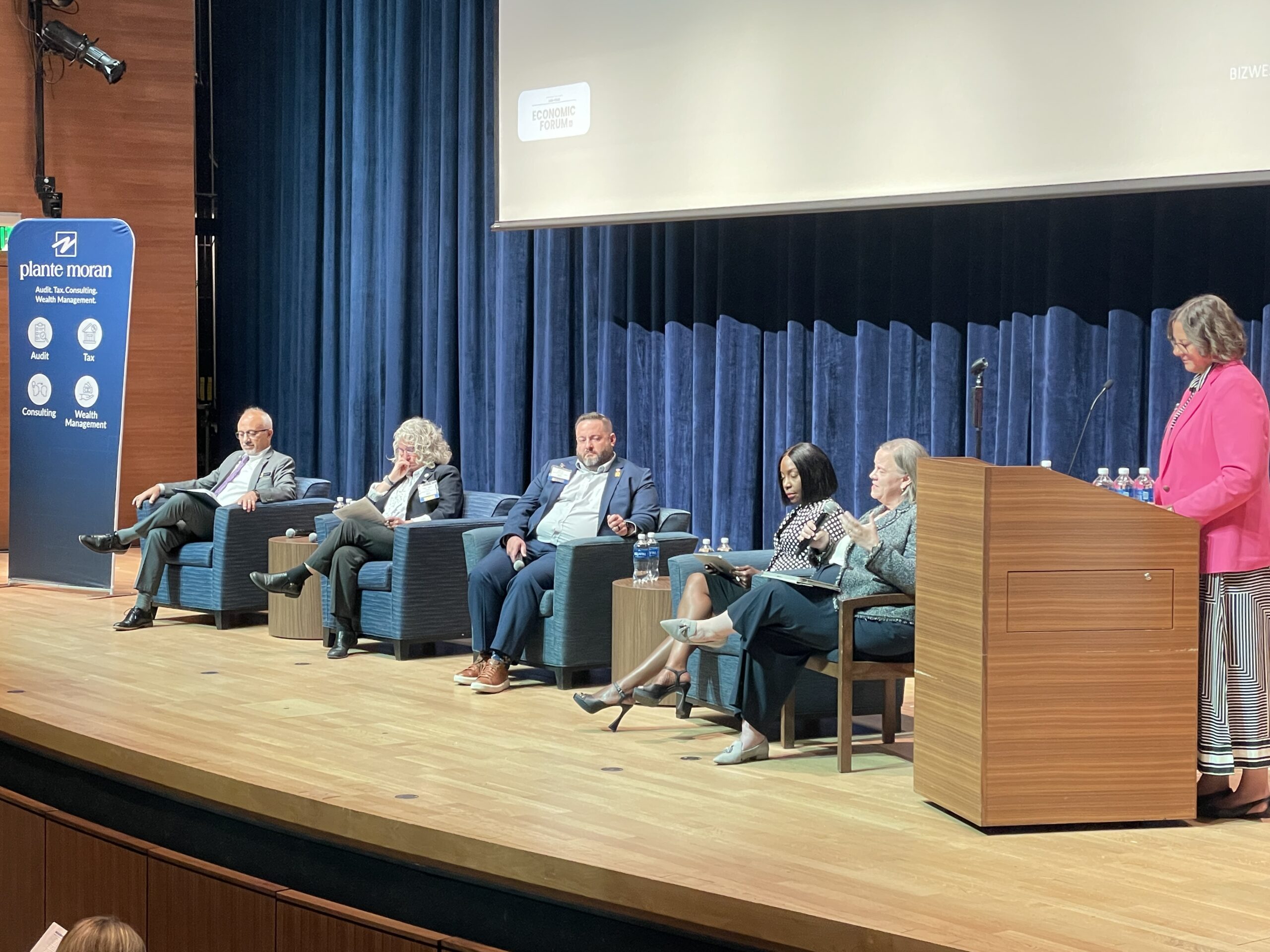
GREELEY — Shifting demographics and changing workforce needs require higher education to constantly evolve in how it engages students, industry and the workforce, higher-ed leaders said Tuesday.
Leaders from Aims Community College, Colorado State University, Front Range Community College, the University of Colorado Boulder and the University of Northern Colorado spoke at BizWest’s inaugural Northern Colorado Mid-Year Economic Forum held at the UNC Campus Commons in Greeley.
Key to that higher-ed evolution is cooperation among institutions, said Colleen Simpson, president of Front Range Community College, which operates campuses in Fort Collins, Longmont and Westminster
“Economic development is people development,” Simpson said. “When we think about what we do here in higher education, we have to see ourselves as one connected talent ecosystem. There’s a role for everyone in higher education: the community colleges, the four-year universities, the technical schools, because our communities need all of us, and finding that balance, finding that place, so that we are educating learners that are going back, so that our business centers are able to grow, and then our communities are able to grow.”
Cassandra Moseley, vice president of research at CSU, highlighted major areas in which the university is responding to critical needs in the economy, including the new ATLAS fusion-research facility, a new veterinary teaching hospital, continued energy and grid research at the Energy Institute and Powerhouse Energy Campus, a joint nursing degree with CSU-Pueblo and continued breakthroughs in infectious-disease research.
She noted that CSU has dedicated spaces for companies that partner with the university.
“We rent out space to them, and they work with our students, with our faculty, to both solve those research problems, but also provide an economic future,” Moseley said.
Kamel Haddad, interim president of UNC, noted that a significant number of UNC students are first-generation. UNC’s biggest competition is not the other institutions of higher education in the region, but individuals who opt against a college education.
“Our No. 1 competitor is ‘no college,’” he said. “The students that we are attracting are ones that are on the fence as to whether they should go to higher education or not. And we’re very proud of the fact that we’re changing those minds.”
UNC has strength in educating teachers, as well as nurses, and in July opened the College of Osteopathic Medicine, the state’s third medical school. Haddad said it’s estimated that the college will have a $1.5 billion economic impact and will help address the shortage of primary-care physicians, especially in rural areas.
“This is an example of where we are responding to workforce-development needs,” he said.
Ann Stevens, provost and executive vice chancellor for academic affairs at CU Boulder, said demographic changes, including an aging population with fewer 18-year-olds, means that higher-ed institutions must work hard to provide value to students.
“I think we are in a challenging time,” Stevens said, “but there is a response that can be very positive, and that is for us to be thinking about how to be more effective at our mission. … This is a time where we can do better, and there are good reasons that we will have to do better.”
That means being aware of workforce needs while also producing well-rounded students who are prepared “for the long haul” and “ready for long careers,” she said.
Larry Pakowski, vice president of academic affairs at Aims Community College, said economic conditions mean that higher-ed institutions must take on non-traditional roles to ensure that students receive all the resources they need. He noted that usage of Aims’ Arty’s Pantry, which provides free food, school supplies and personal-hygiene products to students in financial need, has surged.
He said Aims is working “to meet the basic needs of our students to ensure that they have the tools to be successful in the classroom without having stress and anxieties and all other things going around.”
Shifting demographics and changing workforce needs require higher education to constantly evolve in how it engages students, industry and the workforce

Related Posts
-

WINDSOR — Multiple economic developers, their agencies and area organizations were recognized as part of…
-

General-admission pricing ends Thursday, Jan. 9, for BizWest’s 2025 Northern Colorado Economic Forecast, to be…
-

Broomfield won the Large Community of the Year Award this month during the Economic Development…
-

BOULDER — The U.S. Space Force, the Universities Space Research Association and the Air Force…
