
Local quantum firms look to cash in on federal largesse
Quantinuum, Infleqtion, Atom Computing could get hundreds of millions in incentives

The U.S. Department of Commerce is providing incentives worth as much as about $2 billion to domestic companies advancing quantum technology and local firms in the Boulder Valley are among those looking to take advantage.
Infleqtion Inc. (NYSE: INFQ) has inked a deal with the department’s CHIPS Research and Development Office that could provide the Boulder quantum firm with as much as $100 million in new funding, should it reach certain technological development milestones.
“The (letter of intent) contemplates a portion of the award being funded up front and the remainder funded on a milestone-based award structure tied to eligible project costs and technical progress. The LOI also contemplates taxpayer upside through the issuance of Infleqtion common stock to the Department on the award date with a value of $100 million at a 15% discount to market based on the closing price on the execution date of the LOI or the definitive agreement, whichever is lower,” Infleqtion said in a news release. “The securities are expected to be held on a passive basis. Final terms remain subject to definitive award documents and required approvals. The proposed funding is contingent on completion of diligence and definitive award documents and internal approvals of the U.S. Government.”
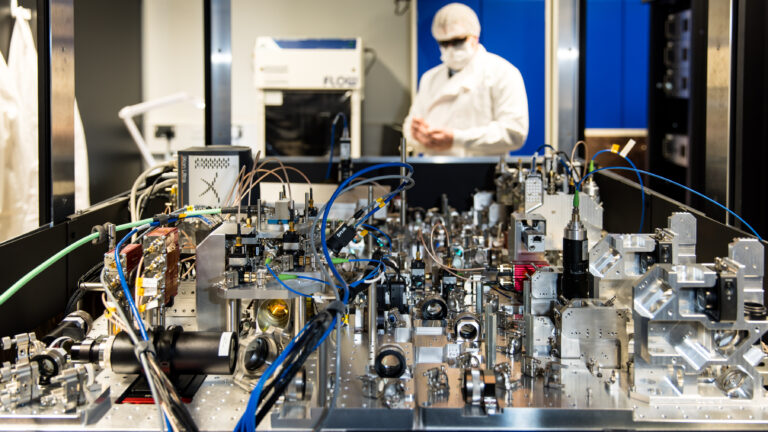
Infleqtion, which went public in February through a special purpose acquisition company merger, uses neutral-atom technology to build quantum computers, quantum clocks, RF receivers and inertial sensors.
Because neutral atoms don’t have a positive or negative charge, the company claims, they can be bundled together more densely than charged particles and arranged in ways that make Infleqtion’s quantum hardware more scalable than existing supercomputer technology.
“With today’s CHIPS Research and Development investments in quantum computing, the Trump administration is leading the world into a new era of American innovation,” Commerce Secretary Howard Lutnick said in the release. “These strategic quantum technology investments will build on our domestic industry, creating thousands of high-paying American jobs while advancing American quantum capabilities.”
Atom Computing Inc., a California-headquartered quantum firm that hosts the lion’s share of its workforce and research and development efforts in Boulder, has signed a similar LOI with the Commerce Department that could also be worth up to $100 million.
“This investment will allow us to move faster than ever and strengthens the United States’ leadership in quantum computing,” Atom Computing CEO Ben Bloom said in a statement. “With this support, we will be accelerating key engineering advances needed to deliver full-scale quantum systems powered by our neutral-atom technology.”
Atom’s federal funding will be used to “address key technical and manufacturing challenges for neutral-atom quantum computing, including hardware development and systems integration needed to manipulate, control, and address tens of thousands of qubits, and validate their performance,” according to the National Institute of Standards,a Boulder-based federal agency that has been a key player in the development of quantum technologies.
Quantinuum Inc., a Broomfield-based quantum-computing company that intends to soon go public, also has a new $100 million pact with the federal government.
Those incentive dollars will be used to help Quantinuum develop “critical technology and manufacturing bottlenecks for scaling of fault-tolerant trapped-ion-based quantum computers, such as low-loss integrated photonics, and reliable optical components at trapped-ion critical wavelengths,” according to NIST.
Quantinuum is developing quantum-computing software applicable to industries such as pharmaceuticals, cybersecurity, materials science, specialty chemicals and agrochemicals.
The Denver Business Journal recently reported that Quantinuum has leased more than 100,000 square feet of new Broomfield office space, more than doubling its footprint in the Interlocken business park.
While the Trump administration is being openhanded with companies that are commercializing cutting-edge technologies, the federal government is at the same time attempting to slash funding for many of the federally supported laboratories and universities where these technologies originate.
Quantum theory attempts to explain the behavior of matter at atomic and subatomic levels. Because quantum computers take advantage of special properties of quantum systems such as superposition, their computing power and speed are exponentially greater than a traditional computer. The federal government has long sought to incentivize the development of quantum technology both for economic and national-security purposes.
The Boulder Valley — with the University of Colorado physics department, the NIST and JILA (formerly known as the Joint Institute for Laboratory Astrophysics) — has become, over the past three decades or so, the epicenter of quantum research.
“When people ask me what our goal should be when it comes to quantum, I always say, ‘World domination,’” University of Colorado president Todd Saliman said this week of the region’s role in the global quantum ecosystem.
The U.S. Department of Commerce is providing incentives worth as much as about $2 billion to domestic companies advancing quantum technology and local firms in the Boulder Valley are among those looking to take advantage.
Related Posts
-

BOULDER — Infleqtion is one of the participants in the first round of the U.S.…
-
Infleqtion, a quantum information company, has hired Pat Tang as its chief technology officer.
-

“When people ask me what our goal should be when it comes to quantum, I…
-
Infleqtion and Churchill Capital Corp X have filed merger registration paperwork with the U.S. Securities…
