
Boulder Valley ReCon: Local relationships trump consolidation for agents
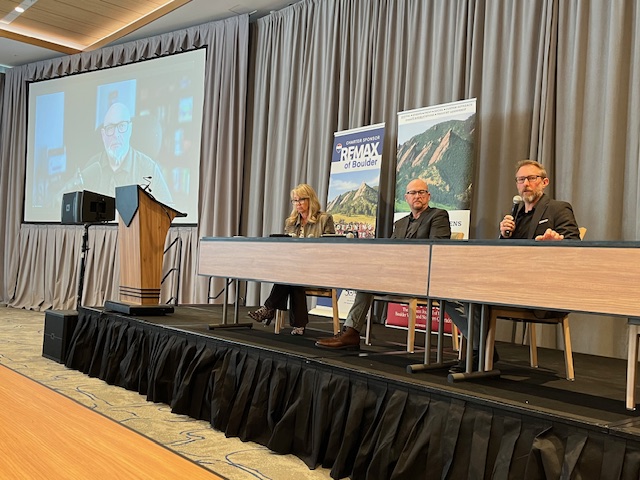
BOULDER – The residential real estate industry, made up of the folks who help consumers buy and sell homes, faces massive consolidation and change driven by corporate mergers and artificial intelligence, but for the local agents, relationships remain the key to success.
So said three real estate professionals who appeared at BizWest’s Boulder Valley Real Estate Conference on Thursday. Lisa Wade, a broker associate at Re/Max of Boulder, moderated the discussion.
Keith Robinson, president of NextHome Inc., kicked off the discussion with his insights regarding entities that specialize in private listings. Such entities build walls around those listings in an effort to shut out competing real estate companies.
Robinson said he sees 2027 as a watershed year in which the industry will figure out whether such approaches are beneficial to consumers. “As an industry, we’ll figure it out,” he said.
He said in his area of Danfield, California, about a third of the available inventory of homes for sale are “opaque” or unavailable to people who search multiple listing services for opportunities. “This isn’t the experience that people want. How will some of the smaller operators compete? Personally, I don’t think the juice is worth the squeeze on this approach.”
Robinson expects that mergers among the giant real estate listing companies will result in “big companies at the center and little companies on the outside looking in.”
His concern with consolidation: “With too much consolidation, you lose the advantage of competition.”
Jay Kalinski, broker/owner of Re/Max of Boulder, noted that the national Re/Max operation has been acquired by The Real Brokerage Inc. “They are not buying agents; they are buying the funnel. Scale does buy some things,” he said, referencing access to health insurance and employee benefits.
“But what does ‘local’ give a seller that ‘big’ can’t? Sellers care about you and what you know about their street and house,” he said, making the case for the one-on-one relationship that local Realtors can provide.
“Private listings are the velvet-rope economy. It’s a fight over who holds that velvet rope,” he said. “Private isn’t the problem. Uniformed consent is the problem. If a seller wants to sell privately, they deserve to know the cost of that. Some sellers may have reasons for privacy. In Boulder now, exposure needs to be the strategy,” Kalinski said, because there may be buyers outside the velvet rope who would be interested in the property. Local Realtors know that about the local marketplace that big, AI-driven entities do not.
Clint Skutchan, founder of real estate consulting firm Twenty-Two, said while local Realtors face pressure from consolidation among the major the giants in the listing industry, they also face challenges from consolidation among multiple listing agencies.
He said more than four in 10 MLSs have consolidated since 2015, a 43% decline, yet listings appear in more places than ever. Some of that comes from agents listing properties in more than one MLS, but also artificial intelligence has resulted in more of those listings showing up in other places.
Skutchan also said that consumers may not be aware of the consolidation in the listing industry. While the giants may be buying up more and more local agencies, they often don’t change signage, leading consumers to believe that nothing has changed.
But “do the services remain the same under the larger corporate ownership?” he asked.
All three panelists spoke to the impact of artificial intelligence, with local agents advised to get on board with the tools that AI provides.
“Are clients going to use an AI bot to buy a house? The answer is yes. … Will it happen at scale? No,” said Robinson. “… FSBO (for sale by owner) is 5% of the market. I wouldn’t lose any sleep over 5% of the market.”
The current moment is “an amazing time to be exceptional. If you think you’re exceptional (as a real estate agent), I’ve got great news for you. You’ll continue to be exceptional. … It’s a bad time to be average.”
Both he and Kalinksi said that relationships remain the key to the industry, and AI won’t change that.
Robinson said curiosity and writing are two skills that Realtors need to develop. He listed several suggestions about how agents can use AI. Among them:
- Prompt like a pro. Have AI write the prompt for you.
- Let it run your inbox and calendar.
- Use it to write listing copy; train it to your voice.
- Use it to research your newsletter. That makes generating newsletters a much quicker process.
- Use it to rehearse the hard conversation.
- AI can help prepare for the listing appointment.
- AI can build a followup message system.
- And the technology can write a script for a listing reel.
Kalinski said that the National Association of Realtors reported that only 21% of agents have used AI, with more who will adapt.
“We’re winning on trust,” he said, but just barely. “Sixty-two percent of consumers say that real estate agents make them smarter, and 61% say that AI makes them smarter,” he said.
“This is still a relationship business. Mergers and AI can’t take that from you,” Kalinski said.
The real estate industry faces massive consolidation and change driven by corporate mergers and artificial intelligence, but for the local agents, relationships remain the key to success.

Related Posts
-

BOULDER — Chick-fil-A has donated $250,000 to two Boulder Valley nonprofits through the company’s True…
-

The Downtown Boulder Partnership, Visit Boulder and the Boulder Chamber are launching a new initiative…
-
After cutting several programs and positions over the summer, Bridge House, a Boulder-based nonprofit organization…
-

The City of Boulder and Boulder County will host a community roundtable on April 12…
