
The HIVE adds family justice center to safehouse offerings
FORT COLLINS — Victims of domestic violence seeking assistance from Crossroads Safehouse & Services regularly struggled to complete all of the paperwork necessary to access the array of different services coordinated by the Fort Collins-based nonprofit center.
But with the recent opening of The HIVE: A Family Justice Center, they can fill out a single form and tell their story just once to connect with the 20 agencies operating out of the services hub. The HIVE is for survivors of domestic violence, sexual assault, sexual trafficking, child abuse and stalking of all ages, with those 12 and older able to seek support as an individual and under 12 with a parent or guardian.
The streamlined in-take process “helps with (reducing) re-traumatization in those cases,” Crossroads executive director Lori Warren said.
Crossroads Safehouse reconfigured 10,000 square feet of the safehouse building and remodeled several unused offices to create The HIVE, a project that cost $500,000.
An acronym for Hub for Information, Validation, and Empowerment, The HIVE officially opened April 2 following a soft opening in January. It’s the third family justice center to open in the state — the other two are the Rose Andom Center in Denver and PorchLight, A Family Justice Center, in Lakewood.
Crossroads Safehouse is an overnight shelter with 26 beds for survivors of domestic violence, while The HIVE is open during business hours Monday, Tuesday and Thursday from 10 a.m. to 6 p.m. The two areas are separated by several security features.
Modeled after nationally recognized family justice centers, The HIVE consists of separate spaces for administration and participants.
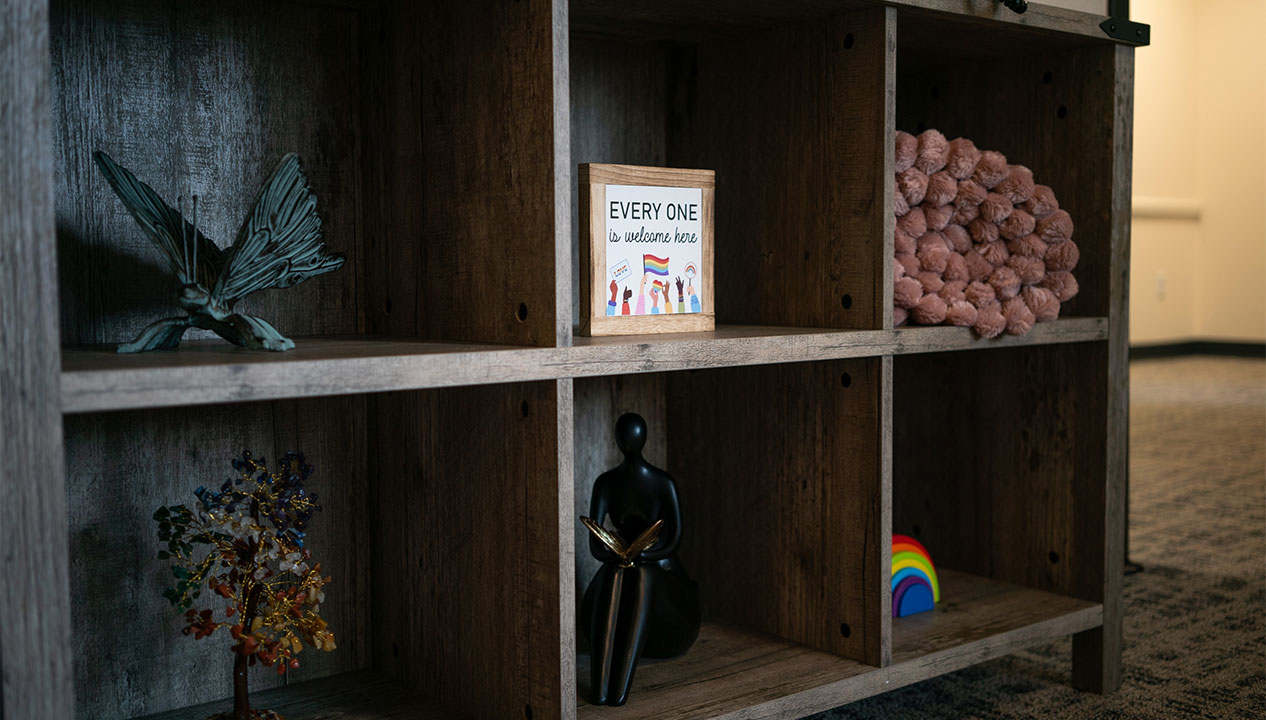
“That particular space feels calming, welcoming and homelike,” Warren said of The HIVE space.
The HIVE has eight trauma-informed therapy rooms with soft furnishings, a clothing boutique, access to basic hygiene items, a food bank, a beverage and snacks cart, and a medical unit with volunteer physicians who provide basic medical services and vaccinations, as well as a large community conference room. The clothing for the boutique is donated, as is the food, which comes courtesy of the Food Bank for Larimer County and Vindeket Foods, a food rescue that partners with grocery stores, restaurants and farms to reduce food waste.
“It’s a space that makes someone feel very comfortable. It doesn’t have the same sterile feel as an office,” Warren said. “We tried to put art all around and flower arrangements all around, and the furnishings have rounded edges instead of square ones. … We are trying to create soft spaces.”
One of the therapy rooms is next to a children’s play room with a window, so that families can see each other and stay visually connected. Any physical separation can feel traumatizing, according to some of the survivors who spoke up in survivor focus groups that Crossroads created to gather feedback on the final buildout of The HIVE.
“The child can be playing and having fun, while the parent is having a personal conversation with the provider,” Warren said.
The HIVE serves as a resource hub for wraparound services, bringing together multidisciplinary partners under one roof, including advocacy, law-enforcement support, victim-service providers, counseling, medical care, housing and employment navigation, benefits enrollment, legal services and financial education. Partners include the District Attorney for the Eighth Judicial District, Fort Collins Police Services, the Loveland Police Department, the Sexual Assault Victim Advocate Center (SAVA), Homeward Alliance, Neighbor to Neighbor, Alternatives to Violence, UCHealth Forensic Nurses, KeyBank, The Initiative and ChildSafe Colorado.
“Survivors of sexual and domestic violence are navigating many complex systems while simultaneously navigating healing,” said Alison Jones-Lockwood, CEO of the SAVA Center. “When we can reduce barriers, like transportation, resource mapping, etc., survivors are more likely to access and utilize support services. Ultimately, this is what we want for survivors — we want them to be aware of what help is available, and ease of accessing help.”
When survivors can go to one place and get support from multiple service providers, their barriers to accessing help are reduced, she said.
“This one-stop-shop model simplifies help-seeking, provides access to resources the survivor may not (yet) know they need, and provides a calm, caring environment to get the support they need,” Jones-Lockwood said.
The goal is to eliminate the need for survivors to navigate the multiple, complex systems alone.
“People can seek services and build a sense of community over several months,” Warren said. “As long as they need us, we are here. … I can’t wait to see all the people who this will benefit. “
The HIVE has served 25 survivors and their children in the first two weeks of operation and hopes to serve 350 or more in its first year, she said.
“We know it takes time to get these programs up and running,” Warren said.
Bringing The HIVE to fruition took about 18 months, starting with survivor surveys and individual and group meetings with staff, leadership in partner agencies and the larger community to gather ideas and input.
“Naming this (new facility) was the hardest part of the entire process,” Warren said. “It’s so important, because it can draw people in or drive people away.”
Some of the survivors filling out the surveys said that the term “family justice center” can sometimes feel vague, she said. Alternatively, The HIVE feels warm and welcoming, evoking shared access to information that allows the survivors to make their own decisions, while validating and empowering them along the way.
“The creation of this was very survivor-led,” Warren said. “Their feedback created what this space looks and feels like and the services that are provided.”
Research shows that communities with a family justice center see a 50% decrease in domestic violence deaths, Warren said. “The reality is they get the services they need, because there aren’t the barriers preventing them from doing so. It allows them to fully heal and thrive.”
Operations of The HIVE are funded by local and federal grants, foundations and individual support. One full-time and one part-time staff member was added to the Crossroads staff of 23 to operate The HIVE, with managers and directors at Crossroads also helping oversee it.
“This has been a proud time for our community coming together, our agencies coming together, to do hard things,” Warren said. “Our community has come together and said they are going to fund this, because it’s so important.”

Related Posts
-

BOULDER — There With Care, a Boulder-based nonprofit that provides assistance to families with children…
-

Human Bean Northern Colorado will conduct a Guest Barista Day on Thursday, March 7, at…
-
Human Bean Northern Colorado will conduct its next Guest Barista Day, April 14, benefiting Joy…
-

The Lincoln Center’s Cozy Coats pet-supply drive, benefiting The Street Dog Coalition, will take place…
