
Landowner alleges Weld commissioners bent rules for data center
GlobalAI project presents ‘existential threat,’ developer says
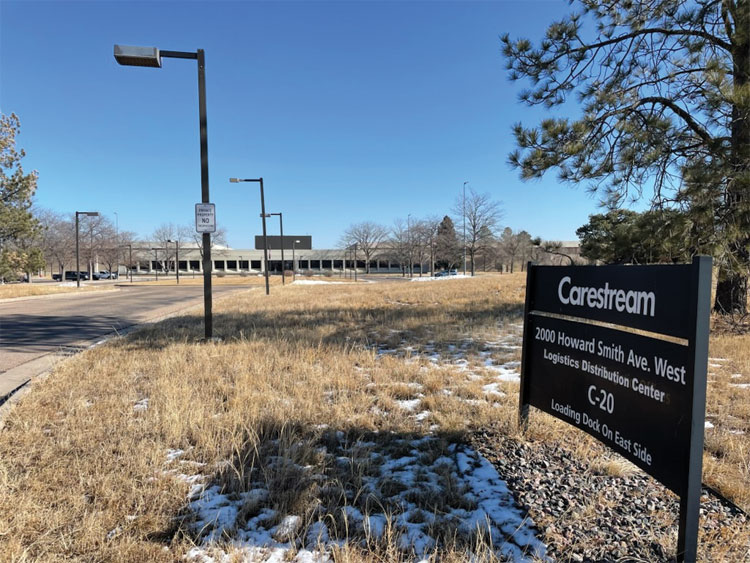
WELD COUNTY — The owner of the industrial park adjacent to a proposed massive data center has sued the Weld County commissioners, alleging that they manipulated county rules, ignored construction violations and improperly assisted the developer in securing approval for the project.
The plaintiffs are affiliates of Denver-based Broe Cos., a privately held investment group with interests in real estate, railroads and energy. Broe owns and operates the 3,000-acre Great Western Industrial Park, one of Northern Colorado’s largest industrial developments that includes Vestas, Owens-Illinois and other uses.
In a 24-page complaint filed Tuesday in Weld District Court, plaintiffs GWIP Land Co. LLC, Windsor Renewal I LLC and GWIP LLC seek to overturn the commissioners’ September approval of GlobalAI Cloud Inc.’s data center on the former Carestream Health property.
The City of Greeley recently annexed 325 acres of the Great Western Industrial Park and signed a pre-annexation agreement with GlobalAi.
The lawsuit alleges that commissioners improperly intervened to help GlobalAI secure electrical power, changed county regulations to accommodate the project and failed to enforce three stop-work orders issued after construction began without proper permits. The lawsuit seeks judicial review of the commissioners’ approval of the project due to several alleged violations.
“WRI … respectfully asks this Court to find that the USR (a governmental approval called “use by special review”) must be reversed because the BOCC (Weld County Board of County Commissioners) exceeded its authority and abused its discretion by misconstruing and/or misapplying the law,” the lawsuit states. “The approved USR will dramatically increase the intensity of allowable uses at the subject property and impair the property rights of all surrounding land users as a result of the project’s unquantified water demands, its energy consumption that places the surrounding grid at risk of failure, and its excessive noise pollution.
“WRI has taken the unprecedented step of opposing a use in its own industrial park because GlobalAI has no plan to secure power or water, relies upon shared systems in the park, and its impacts to those systems and surrounding properties present an existential threat to operations,” the complaint states.
The commissioners in September unanimously approved a use by special review permit allowing GlobalAI to build and operate a massive data center on the 438-acre Carestream Health facility. This came despite an eight-hour hearing in which residents sounded off overwhelmingly against the project. Residents have since initiated a petition drive to force a public vote on the project.
“GlobalAI has intentionally segmented its project into smaller, less objectionable requests so as to evade meaningful public input,” the complaint states. “For instance, GlobalAI has trumpeted the 200 jobs that will supposedly be created by the fully phased project while avoiding the referral process required for a project that will ultimately consume more power than 200,000 Colorado homes.”
Digging into public records, the plaintiffs in the lawsuit allege a systematic pattern of abuse by commissioners beginning earlier this year to circumvent its own rules to approve the data center. Additionally, the lawsuit states, area utilities likely will not be able to provide enough power or water for the data center, while also accommodating existing loads. The lawsuit alleges that details of necessary utility needs were ignored to push through the project, which is said to bring with it construction jobs to the area. The project, the lawsuit states, also will exceed county noise limits.
The lawsuit states that the commissioners toured a data center in Cheyenne, Wyoming, in late 2025 or early 2026 to prepare themselves for locating a data center in Weld County. In doing so, the lawsuit alleges, the commissioners violated Colorado’s Open Meeting Law by failing to notify the public about the meeting and discussing public business. “This off-the-record information gathering influenced multiple commissioners’ views of data centers and the USR application,” the lawsuit states.
The pattern continued in January, with Commissioner Kevin Ross lobbying to secure a power source for the project, the complaint alleges. Western Area Power Administration at the time was refusing to provide GlobalAI use of its transmission lines to get power, the lawsuit states. Due to that lobbying, the lawsuit states, Ross should have recused himself from voting on the project.
“Weld County Commissioner Kevin Ross emailed representatives of Western Area Power Administration,” the lawsuit states. “Commissioner Ross stated that ‘the proposed project for Global AI is a very important project for us here in Weld County’ and he was made aware that ‘WAPA has gotten involved and is not allowing transmission over the lines to get the power to the end user.’ Further, ‘[t]here needs to be a solution found here…’, ‘[t]ime is also of the essence here…’, and ‘[w]e have to move rapidly.’
“Commissioner Ross pointed out the fact that the Data Center Code Amendment is directly tied to the Project, as ‘Weld [C]ounty has made the necessary changes to our code to accommodate data centers because we know the immediate importance of this project.’ Commissioner Ross then requests WAPA ‘reengage/ reopen discussions with Global AI to help find a solution.’”
Contacted Thursday, Ross said he could not provide comment on the lawsuit. Likewise, Weld County’s public information officer Jennifer Finch, the government’s custodian of public records and a named defendant in the lawsuit, stated that she would send a request for comment to the commissioners, but they likely could not comment because it is pending litigation.
The lawsuit noted that Weld County’s director of oil and gas energy, Brett Cavanagh, stated that oil and gas companies already are running up against situations in which utilities cannot provide the power they need.
“Allocating a substantial amount of capacity (equivalent to the annual use of approximately 38,000 average Colorado homes) to GlobalAI could further limit operators’ ability to meet state and permit-specific electrification requirements,” the lawsuit states.
The lawsuit states that the county did not contemplate data centers in its land-use code, but quickly moved to add them. It alleges the elected officials looked the other way when GlobalAI failed to provide details on its expected water usage beyond the closed-loop cooling system’s initial 65,000 gallons of water, and 6,500 gallons a year to replenish it.
The lawsuit also alleges that commissioners ignored enforcing three different stop-work orders on the project, the first of which was on May 7, after GlobalAI began construction without the proper permits. The data center company “stated that if the County wanted to stop construction, they would need to send the sheriff,” the lawsuit claims. The county did not call the sheriff, the complaint added.
In June, the lawsuit states, the commissioners revised the County Building Code to restructure its Board of Appeals and Zoning Compliance, which had previously consisted of building-trade experts, to include members of the County Commissioners. “The BOCC amended the appeal process to ensure that the board of tradespeople would not act to shut down GlobalAI’s ongoing construction,” the lawsuit states.
A second stop-work order came on June 11, followed by a third on July 20, both of which GlobalAI ignored, the lawsuit claims. On Aug. 16, GlobalAI provided notice to the commissioners that it planned to appeal the stop-work orders.
The next day, GlobalAI and the county entered into a memorandum of understanding that GlobalAI would drop its appeal and the county would not enforce the violations, also agreeing to move up the data center proposal’s special review by two weeks, the lawsuit states.
“In short, the County not only agreed to excuse more than three months of illegal construction at the Property, but it also agreed to reward GlobalAI by bringing forward consideration of its USR on an uncommonly accelerated timeline, so as to not negatively impact GAI’s construction schedule.”
The lawsuit also alleges that the county delayed a public information request and prevented inspection of 21 emails related to the project, citing attorney-client privilege. The plaintiff, Windsor Renewal, paid $330.96 for the public records. The lawsuit claims that the government failed to produce the requested documents in accordance with state requirements. County officials never provided reasons why it was prohibiting the release of the emails, the complaint states.
The county also failed to provide a timely response to a second open records request for information relating to the stop-work orders. The CORA request sought text messages between Commission Chairman Scott James and GlobalAI chief operating officer Michael Cardigan. To date, the referenced ex-parte text messages have not been disclosed, the lawsuit states.
“The procedure for the approval of the USR lacked fundamental fairness due to the County’s withholding of relevant documents in USR-related open records requests, reliance on facts gathered during non-public data site visits, ex parte communications with the applicant, and improper consultation with the County Attorney,” the lawsuit stated.
Case cited: 2026CV31187, GWIP Land Company LLC, Windsor Renewal I, LLC; and GWIP, LLC v. Board of County Commissioners for Weld County, Jennifer Finch, in her official capacity as Public Information Officer for the Weld County Public Information Office; and GlobalaiColorado, LLC filed Oct. 6, 2026, in Weld District Court.
The owner of the industrial park adjacent to a proposed massive data center has sued the Weld County commissioners.

Related Posts
-

A company that is building a national network of data centers on a terabyte network…
-
The Weld Community Foundation is seeking sponsors for its Spread the Good luncheon, scheduled for…
-

A newly formed citizens group has launched a two-pronged attack on data centers in Weld…
-
Related Digital, a vertically integrated data-center development and investment platform, broke ground Tuesday on a…
