
Healthcare execs grapple with what problem to tackle first
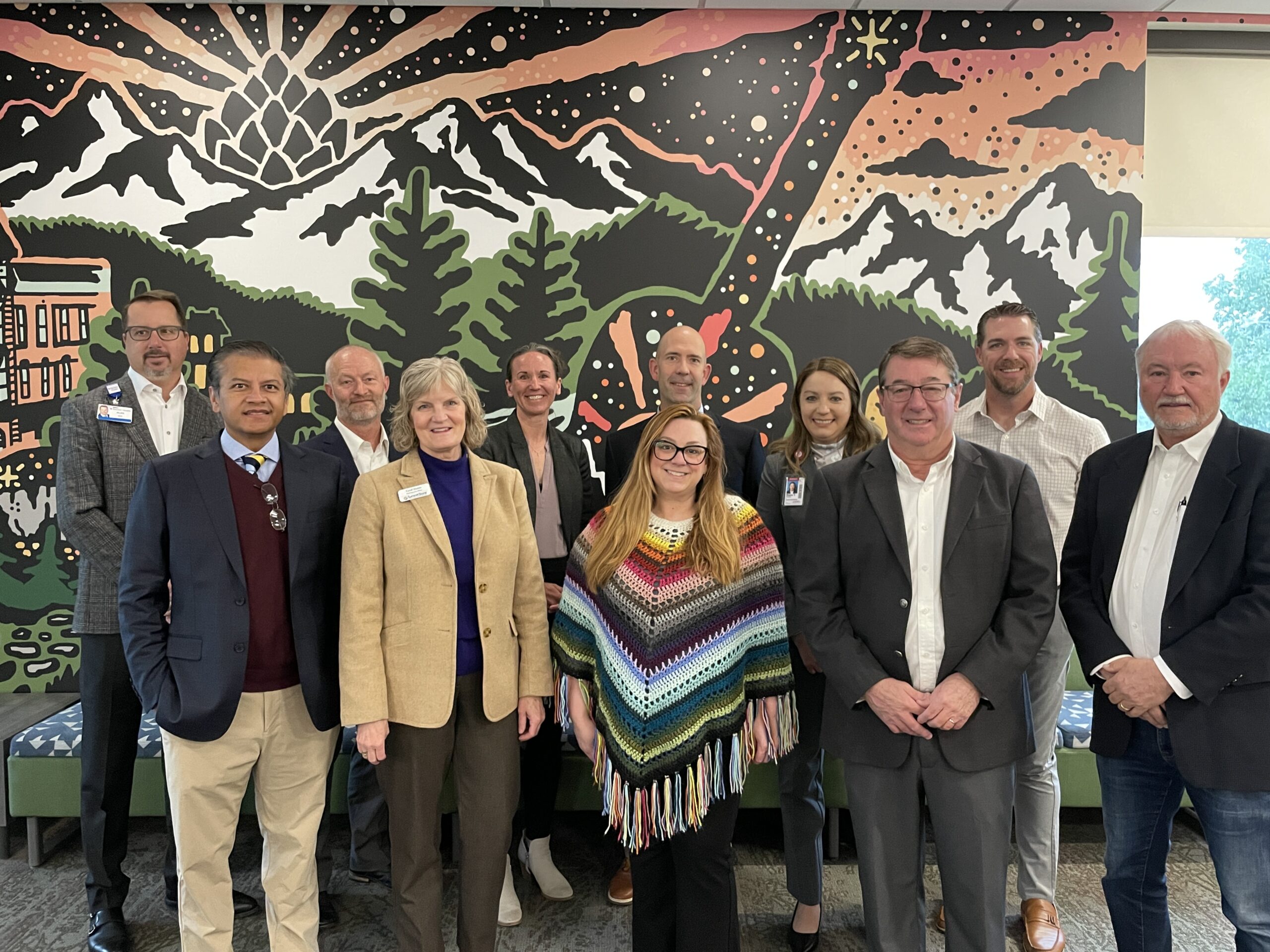
FORT COLLINS — “Where to start, where to start,” might be the nervous mantra of healthcare executives as they arrive at work in a time of great uncertainty in the industry.
Do I work first on recruiting more primary care doctors? Or figure out how to retain those I already have? Or realign how patients can get appointments in a timely manner? Or figure out whether the supplies we need will be hit with a new tariff next week or month? Or determine whether the legislature (or Congress) will further reduce reimbursements in Medicaid and Medicare programs? Or protect healthcare services in small, rural communities? Or find new sources for prescription drugs, perhaps foreign sources? Or how much time to devote to wrestling with insurance companies? Or whether to buy new technology to help deal with patients who might be using nontraditional payment systems that don’t fit with the current insurance model?
Healthcare executives from multiple entities gathered this morning to discuss the issues and share strategies. The forum was BizWest’s CEO Roundtable on healthcare, one of several conducted each year on multiple topics in Northern Colorado under the sponsorship of Elevations Credit Union, Berg Hill Greenleaf Ruscitti law firm and Plante Moran accounting firm.
For Dr. Jamison Bohl, senior medical director in the region for Kaiser Permanente, the shortage of physicians ranks among the top issues. That and bringing down the total cost of care.
With doctor retirements, “we aren’t replacing them fast enough,” he said.
While large organizations such as UCHealth and Banner Health have well-oiled methods to recruit new doctors, even they struggle to find enough care providers given the population growth in the region. While the state’s population growth has slowed, that isn’t the case in Larimer and Weld counties, which are among the fastest-growing areas of the state.
And even when new doctors, including new graduates, are found, the employer relationship has shifted from what it once was.
“New physicians have different expectations (from those they’re replacing,)” said Christin Crosby, chief financial officer for the Orthopaedic & Spine Center of the Rockies. New doctors may place more emphasis on work-life balance. “They don’t want to work like physicians used to work. They don’t understand the business side of the operation, nor do they want to,” she said.
Organizations also feel the impact of the federal Family and Medical Leave Act, which entitles eligible employees to take unpaid, job-protected leave for qualifying family and medical reasons. Having people gone from the workplace becomes difficult to manage, Dodds said. “Nationally, employers are seeing 35% of staff out on leave.”
Alan Qualls, CEO in Northern Colorado for Banner Health, said hundreds of Banner staff members systemwide are out on FMLA leave.
Technology, including increasing use of artificial intelligence, can help bridge the gap between expectations and realities, several participants said.
Bohl said that “ambient listening” technology, which records, organizes and delivers after-visit communications between doctor and patient is one way of helping not only stretch the existing medical workforce but also make life more pleasant for healthcare professionals.
“For inefficient providers, it helps to decrease ‘pajama time.’ For efficient providers, it helps physicians to focus on the patient instead of taking notes.”
Patients seem to appreciate the after-visit communication that comes out of AI systems, causing Grace Taylor, president and CEO of UCHealth’s Greeley Hospital, to quip, “perhaps (AI) is more pleasant” than what a busy doctor might jot in a note.
Qualls said that Banner has been “restructuring its data warehouse” that stores information for its 32 hospitals in the West. Doctors are able to use AI to sort through data to find answers to complicated questions.
Crosby said the orthopaedic center, a “fiercely private” organization, needs to be using it more. The company is using it to optimize medical coding and processing claims. She said “payers, or they should be called nonpayers” are using AI to scrub insurance claims, meaning that healthcare providers need to be using it as well.
She said that her organization uses AI to provide 24/7 access for patients in an effort to provide treatments sooner and keep people out of the emergency room when conditions develop or worsen during hours when clinics are closed.
Dr. Jeff Donner, president of Elite Regenerative Stem Cell Institute, said all providers need to be looking at how they collaborate to lower costs. Among those ways might be organizations such as Amazon, which has a healthcare division that can help providers with back-office services at less cost than might otherwise be the case.
Donner said Elite is also using AI to “leverage biological intelligence” with the aim of teaching the cells of the body to reboot themselves instead of using interventional care.
Scott Dhupar, CEO of Nadora Healthcare, said Nadora is using AI to help with operational processes, including “with minimal input pull all surgical information and transmitting it to areas that need to know,” such as to scheduling, billing, staffing, “so everyone can get the ball rolling at the same time.”
At Pathways Hospice, Evan Hyatt, president, said that the first place the hospice has used AI is in supporting documentation. “That’s how a lot of us get paid, so we’re not missing things.” He also said that payers, whether insurance or governmental programs such as Medicare, sometimes want agencies to look back years into records, and having an AI tool helps.
Insurance brokers, such as Flood and Peterson in Northern Colorado, use AI to help with administrative tasks. Kendra Johnson, a broker with the company, said employers and employees of companies will always want a personal contact but background work can happen within AI.
UCHealth has embraced AI in multiple ways. Taylor ticked off several programs that the hospital system uses, including ambient listening during doctor/patient consultations and Eon, which helps with “incidental findings.”
“When you go in for a CT scan, and something else is found other than what you’re looking for,” doctors can provide treatments earlier and at less cost. Early detection of lung cancer is a specific example, she said.
A new AI technology now being used on a pilot basis in rooms at the newly expanded Medical Center of the Rockies in Loveland is called Hello Care. The program looks for patient cues, she said, using real-time data about heart rates, breathing rates and more so that healthcare professionals can intervene more quickly when patient conditions change.
Cyndi Dodds, CEO of SummitStone Health Partners, said her agency uses AI to help with state-required reporting. And as a UCHealth affiliate, SummitStone benefits from UCHealth’s use of technology.
Healthcare professionals also noted that technology doesn’t replace professional judgments. “It’s (AI) only as good as the information going in,” Donner said.
Reimbursement cuts
Healthcare providers also universally noted that reductions in reimbursements and budgetary cuts of other kinds forced upon them are changing how they manage their systems.
“We’re looking at the state budget crisis and what that means for care,” Dodds said. “How can we continue to serve” patients who rely upon Medicaid, for example.
Hyatt said that hospice, which depends almost exclusively on reimbursements from Medicare, is looking at how it might generate income in other ways. Among the considerations are creation of a PACE, or Program of All-Inclusive Care for the Elderly” in Weld County. The program might provide the means to provide care and generate income from other sources. Hospice also is considering opening a thrift store, which numerous healthcare providers have used to generate income independent of medical care.
Qualls said Banner is focusing on “meeting patients where they are.” He hinted at announcements to come soon that would explain that more fully.
Crystal Goodman, executive director of the Northern Colorado Medical Society, said healthcare providers are concerned about what can be done to retain rural clinics and hospitals, given the Medicaid and other cuts coming from the state.
She said that staffing at senior care facilities is a primary concern, because with rapid turnover in those facilities it is difficult to develop a medical relationship with patients. “How do we pay people a fair wage and retain those employees while giving them opportunity for growth,” she asked.
Donner said that healthcare organizations need to do a better job of working together, even if they’re competitors. “I’d love to see healthcare groups work more closely together. We’ll hit a critical place where we can’t afford this (status quo) anymore. We need to work together.”
The cost of healthcare, coupled with cuts to programs such as Medicaid, are having an impact. Brian Ferrans, executive director of the Northern Colorado Health District, said that his agency’s review of research shows that “80% of people are going to primary-care appointments, so the majority are getting care. But a number are on high deductible plans and are avoiding care.”
Those without insurance will delay care, and that impacts hospitals and care centers when sicker patients seek out emergency care, he said.
Dhupar said Nadora tries to “remove any hurdles that prevent patients from getting in the door. People are consumers, they want to get in right away and be treated very, very well. They’re influenced by other industries,” he said, citing Disneyworld. “It’s incumbent on us to provide that level of service. Healthcare is a right and people want things to be five stars, to be Ritz Carlton service. That’s doable. It means communicating with each employee about standards of care.
“We rely a lot on our physicians to provide excellent outcomes, but everybody else, that’s 80% of the organization, are customer service. These are wonderful first-world problems to have,” Dhupar said.
As an insurance broker, working on behalf of patients looking to cut costs of care, Johnson said that the most common thing she hears is that there’s a shortage of doctors, which means it takes longer to be seen by a doctor. Then, “I hear, ‘where can I find a $350 MRI.’ The answer is out there, but you have to drive” to a distant location, she said.
Executives also express concern about impacts of HR 1, the federal law that is rewriting eligibility and compliance rules for Medicaid and shifting costs throughout the healthcare system.
“Those between 18 and 64 are most at risk of losing health insurance,” Dodds said.
Unforeseen cuts at the state level, “several million dollars worth” beginning Oct. 1 will impact providers, Qualls said. “We walk the tightrope between maintaining safety and quality and getting rid of waste. … There is not a lot of wiggle room between reimbursements and costs of care,” he said.
Taylor said that UCHealth will prepare multiple budgets this year. “We’re looking at things that may or may not occur, so that we have line-of-sight and are prepared and not caught off guard. Yet, it’s inevitable that things will happen, and we’ll have to react,” she said.
Bohl said Kaiser’s focus is on keeping people out of hospitals by providing “additional touches.” “Having a robust chat service and video on demand can provide care wherever a patient is at. Lower cost, higher touch and higher volume,” he said.
Cutting costs of prescriptions may be an answer for both hospitals and patients, the executives said.
Johnson said that from the insurance perspective, 2% of the population drives 65% of the pharmacy cost. “There’s a huge reset in the marketplace,” she said. “Pharmacy spend is outpacing medical spend.”
“We’re also the only country that advertises our pharmacy products. … So what do you do? That’s where creativity comes into play.” Brokers are working with employers and with employees to find direct care solutions — perhaps paying cash to employees instead of providing high deductible insurance plans. Or sourcing prescriptions from other countries to save cost, she said.
CEO Roundtables in Northern Colorado are sponsored by Elevations Credit Union, Plante Moran accounting firm, and Berg Hill Greenleaf Ruscitti law firm.
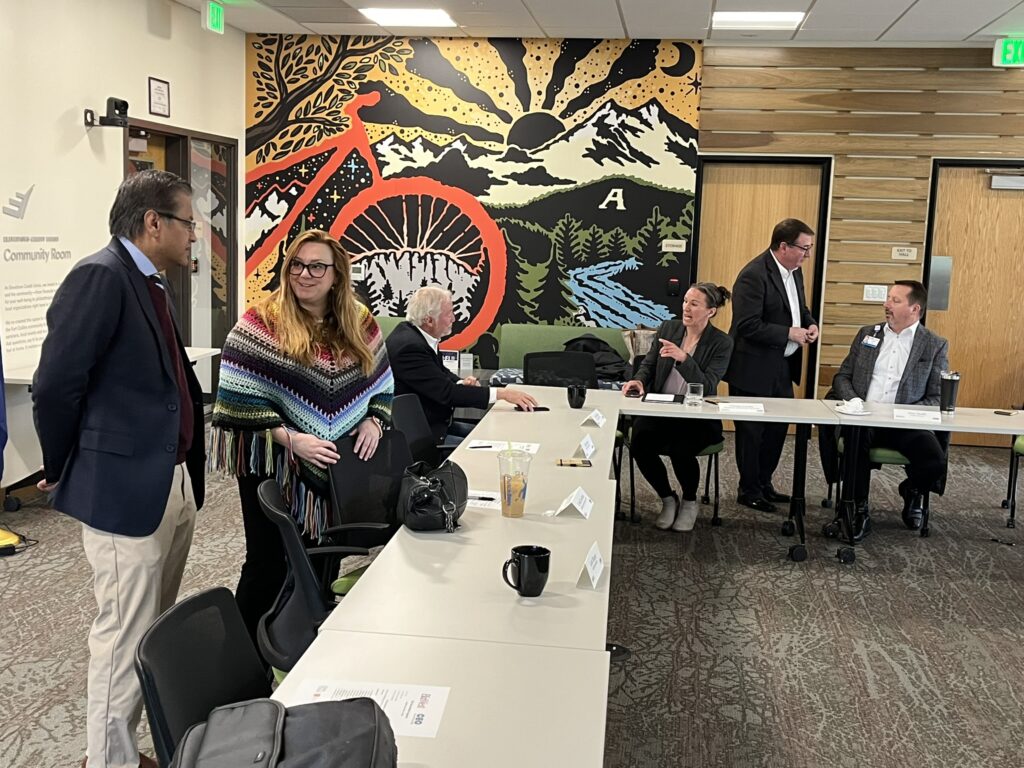
“Where to start, where to start,” might be the nervous mantra of healthcare executives as they arrive at work in a time of great uncertainty in the industry.

Related Posts
-

Cheyenne-based mental health clinic to open in Fort Collins.
-

Aspen Dental opened a new Fort Collins office this week at 3400 S. College Ave.
-

The Colorado Department of Public Health and Environment has petitioned Larimer County District Court to…
-
FORT COLLINS — Lark & Bloom, a home-based baby boutique, has opened Northern Colorado’s first…
