
Developers’, landlords’ task: Shake that empty feeling
Boulder tops nation in percentage of remote workers
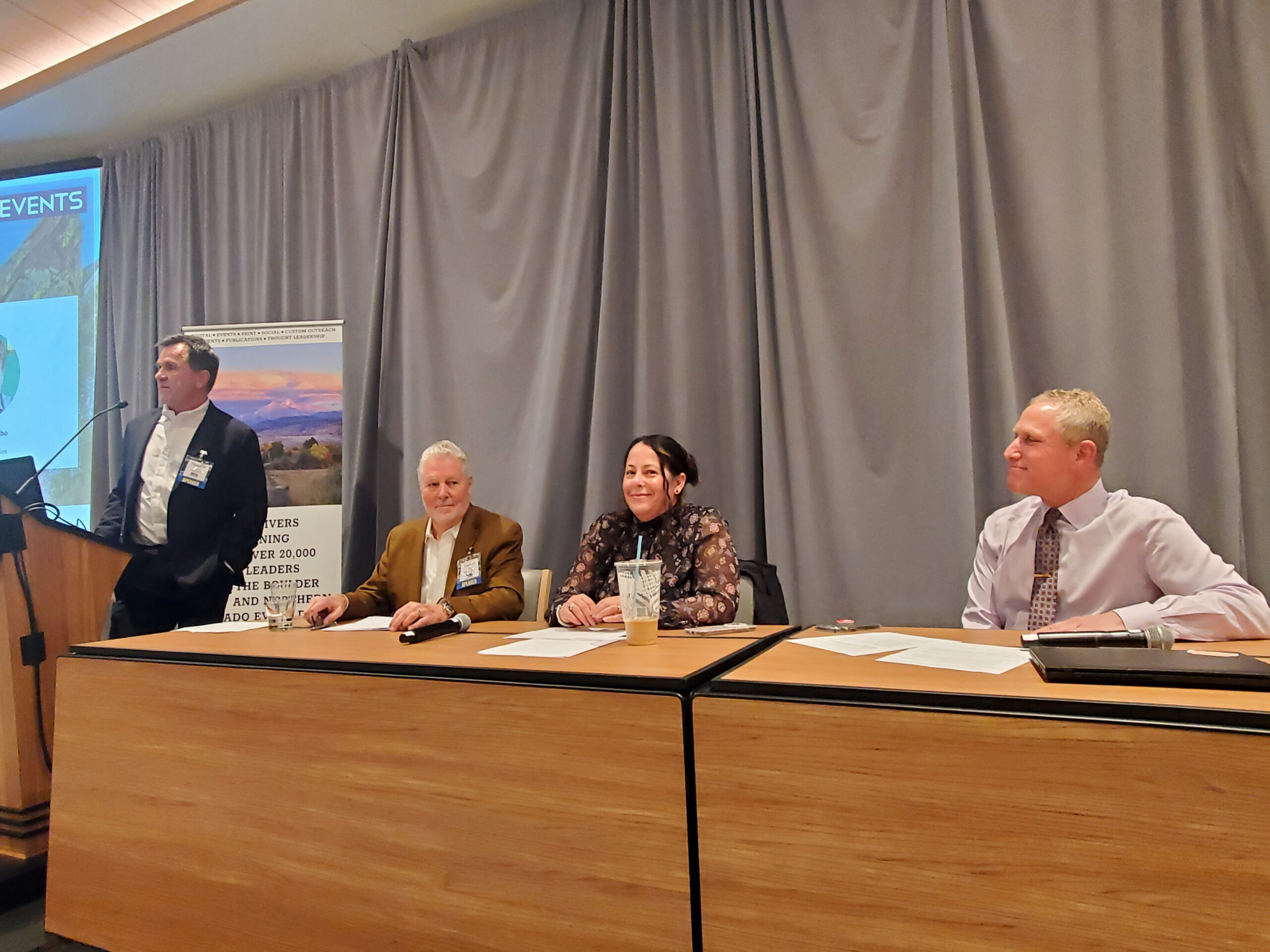
BOULDER — With one of the nation’s lowest rates of workers returning to offices after the COVID-19 pandemic, Boulder is dealing with high commercial vacancy rates. Panels on the commercial and office markets Thursday debated what can be done to fill those empty spaces.
Restrictions imposed by the pandemic sent vacancy rates soaring from 11% to 21% overnight, noted Jennifer Chavez, director of Boulder-area leasing for BioMed Realty LLC, said during the annual Boulder Valley Real Estate Conference presented by BizWest, held this year at the Limelight Hotel in Boulder.
Office vacancy rates nationally have climbed to 14.1%, according to a Wall Street Journal report, and five of the 12 largest U.S. markets have seen vacancies hit a 25-year high. But it’s even more pronounced in Boulder, Chavez said.
“Boulder has one of the lowest rates of return to office,” she said, because “all of us who choose to live and work in Boulder do so for a variety of reasons, many of which are focused around the mountains, our great weather, and want to be outside.
“Roughly 23% to 30% in the Boulder Valley works from home, which is the highest of any city in the country,” Chavez said. “It’s an excess of roughly 30,000 people that are not coming into our community every day. And when we think of this, not only does it affect our office market, but also our small businesses and our retail communities here. Think about your favorite place to go grab coffee, go grab lunch, maybe happy hour. This definitely contributes to the volume of transactions, and creates some headwinds.
“A lot of us love Boulder for the local flavor we have here, so I think it’s really prudent of us to understand the effects that has on our small businesses and our retailers that we love here in the city and the surrounding area.”
That impacts not only the attractiveness of a community to new businesses but also the ability of the city to provide services, said John Tayer, president and CEO of the Boulder Chamber.
“There has been a pall over this town, very much directed to the office vacancies, those empty second and third floors,” he said. “There’s just not that energy that we’ve come to expect in our community. Restaurants and retailers are not exuberant. They’re not feeling the love.”
The result, he said, extends beyond just the 22 open retail spaces downtown.
“Retail sales tax is about 78% of our revenue and about 40% of our city’s budget,” Tayer said. “So it’s hugely important to think about what it will take to bring people back to the office.”
For many business sectors, the five-day workweek is just not coming back, especially in Boulder, declared Beau Gamble, president of Dean Callan & Co.
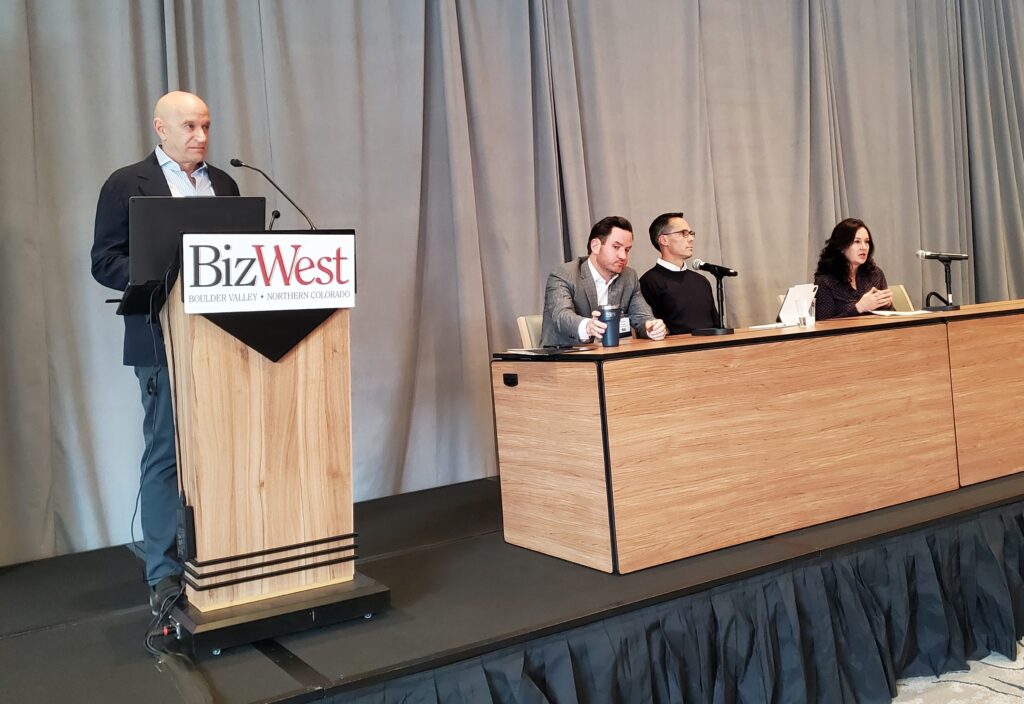
“Google has 1,500 employees. Do they come into work five days? Absolutely not,” he said. “Three is what a Google employee is supposed to average per week. That’s why traffic is heavier on (U.S. Highway) 36 on Tuesdays, Wednesdays and Thursdays.”
However, countered Erik Abrahamson, senior vice president of CBRE, that doesn’t necessarily translate into reductions in needed office space.
“Even though they’re not coming in five days a week, all these employees want their space,” he said. “There’s been a huge pushback on this shared-workspace thing. Maybe you’re not in there five days a week, but you still want your dedicated desk, your office, your space available to you five days a week.”
Abrahamson said “there are companies that do need space and will need space,” singling out manufacturers, quantum computing, aerospace and life-sciences firms.
“These groups are coming back, and they’re coming back full force here in Boulder,” Gamble said. “Those are the types of tenants we hope come and gobble up these vacancies.”
Such companies “need physical space,” added Karla Brown, senior broker and principal at The Colorado Group. “They need power and clear heights and things that can’t be replaced by Zoom.”
Tayer advised developers and landlords to “get connected to some of those business leaders and they’ll tell you what they need.”
Some developers have tried to convert empty offices to residential units, but Brown said the changes to bring them up to standards set by residential codes are often prohibitive. Another challenge, Chavez said, is that many office buildings have no natural light in their cores. However, she added, making them into laboratory spaces is often a viable option.
Vacancies aren’t the only remaining post-COVID headache, said developer Stephen Tebo, owner of Tebo Properties.
During the pandemic, “when interest rates hit 3%, I aggressively went out and refinanced almost all of my portfolio that I could. They were only willing to give me five-year loans at that 3% interest rates, so we took a lot of five-year loans,” he said. “So now all those are coming due.
“We’re working with the banks, and what I’ve found, basically, is that one of the main things the banks are looking at is the history of what the banks have with those borrowers. What have we done in the past? How have they responded? Have they paid on time? That whole scenario.
“So if you get past that,” Tebo said, “then they’re going to be looking at a couple other major things, which would be debt-coverage ratios. Debt-coverage ratios are 1.2 to 1.3, 1.35 – meaning that your net operating income with the current leases that you have has to be 1.2 to 1.35 times the payment you’re going to be making. That’s a number that, with all the office space, is a little tough. So they’re asking, in a lot of situations, to please pay down the loan, give additional collateral, or something else.
“The other thing that they look at, which is very important to the landlord as much as the bank, is the terms of the lease and the stability behind that tenant,” he said. “So if they see a long-term lease and good stability there, they will move a little more on not only interest rates but loan-to-values and extensions. Some of the banks have come back to us and said, ‘OK, instead of 25-year amortization, we’ll go to 30-year.’”
To shake the office market loose, the panelists said, some policy changes are in order, including improvements in the permitting process. Horror stories such as one related by Tebo have hurt Boulder’s image in the region.
“Getting a permit to do a remodel or something is incredibly difficult, and it’s literally killed a few deals we had,” Tebo said. “We had one tenant on Pearl Street that took 405 days to get a permit, and she actually put a sign in the window after 150 days, and every day she would change the number.”
Tayer added that “we have to figure out how to get property tax under control in this town. It seems like there’s not a tax in Boulder that people don’t want to vote for.”
The panelists agreed, however, that the best way to fill vacancies is to make office spaces places where workers want to be.
“We’ve got to get beyond the hurdle of the desire to just work in your pajamas and work behind a computer screen,” Tayer said.
“We need to make the office place itself more attractive, more inviting,” he said, “We also need to make it safe. Make places where folks feel comfortable going out to the parking lot.”
Tebo said he has been adding amenities such as workout facilities and coffee bars to some of his buildings, but some speed bumps remain.
“The problem with downtown Boulder is a couple of things,” he said. “One is parking.”
He described one of his tenants who “had 5,000 square feet and 20-some employees, but it was $150 a month just for the parking.”
Also, he added, “in downtown Boulder, the older buildings don’t have elevators. A lot of the companies require handicapped access.”
Gamble agreed.
“There’s a bunch of old, tired vacant offices in our market, and landlords sat on it, and guess what? Those are still vacant,” he said. “You need to spend the money, put lipstick on the pig, do new carpet, do new paint, and then, guess what? It’ll get leased.”
Brown said offering shorter-term leases would help, as well as “more flexibility in the space and more efficient use of space. Folks are willing to trade square footage for amenities and safety and access to the outdoors.”
Overall, the panelists said, there is plenty of room for optimism.
“We’ve been here before,” Abrahamson said. “We’ve seen vacancy levels like this in the early 2000s, but since then the market’s changed quite a bit. We have a lot more diversification of industries.”
So what to do?
“If you’re a tenant and you have clarity for the next few years, sign a long-term lease now,” he said. “It’s a great time to lock that in.
“If you’re a landlord, it’s coming. Be ready to sign those deals. Tenants are a lot less patient than they have been in the past.”
Chavez echoed the upbeat outlook, noting that “property showings and tours are up significantly.”
Brown, however, added a note of caution.
“On paper, this should be a golden age for tenants, but a lot of them lack the confidence to take advantage of it,” she said. “Boulder ranks No. 1 for hybrid work, so that can throw a kink into employers’ plans for office space.
“It feels less like a golden age and more like an age of uncertainty.”
With one of the nation’s lowest rates of workers returning to offices after the COVID-19 pandemic, Boulder is dealing with high commercial vacancy rates. Panels on the commercial and office markets Thursday debated what can be done to fill those empty spaces.

Related Posts
-

BOULDER — People interested in attending BizWest’s Boulder Valley Real Estate Conference have until tonight…
-

Real estate professionals are eligible to earn seven continuing-education credits at the 18th annual Boulder…
-

BOULDER — Beau Gamble is officially the president of Boulder real estate brokerage Dean Callan…
-
Time is running out to register for the 18th annual Boulder Valley Real Estate Conference,…
