
Healthcare execs seek cures for reimbursement cuts
Impact is 'very, very real'

BOULDER — Finding and keeping their workforces are a continuing struggle for Boulder Valley healthcare executives who attended a BizWest CEO Roundtable last week, but most also said federal cuts to Medicaid reimbursements included in last year’s “One Big Beautiful Bill Act” are causing the deepest concern, both for the institutions and their patients.
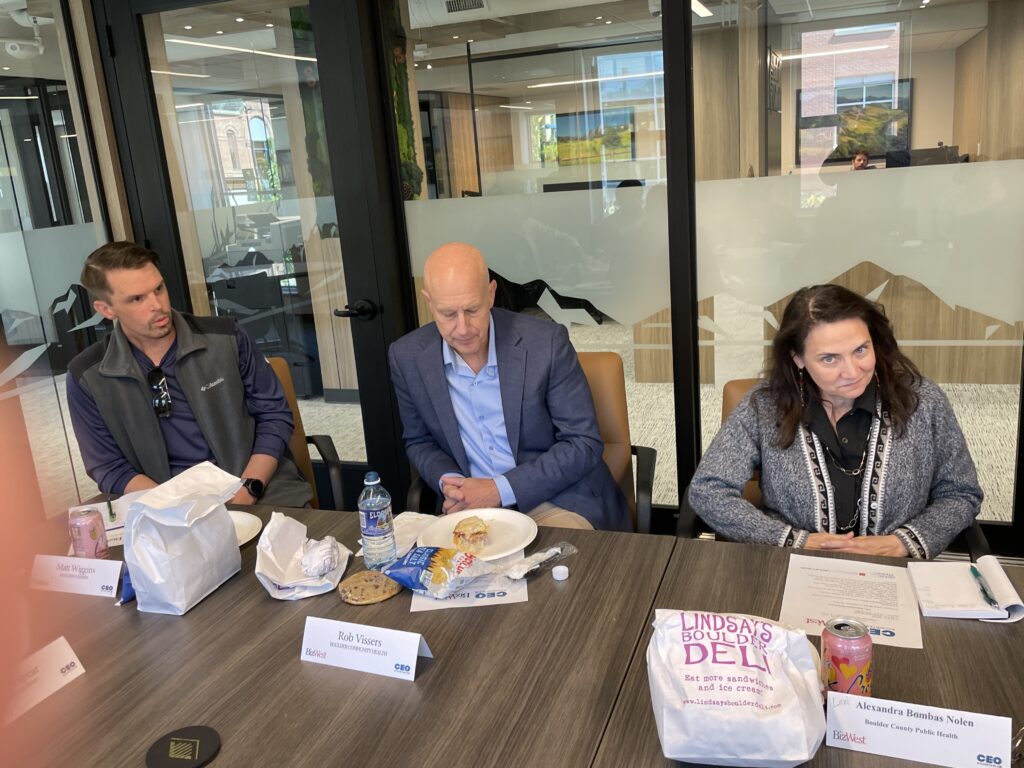
“The impact is very, very real,” said Robert Vissers, president and CEO of Boulder Community Health. “A trillion dollars is not insignificant, regardless of the industry you’re talking about. That’s what’s being taken out of Medicaid over the next several years. And we have not yet fully seen the impact.
“If anything, the predictions around how much it’s going to turn into uninsured, underinsured, people unable to get commercial insurance, we’ve underestimated that,” Vissers said. “So those challenges are real. It’s just greater impetus for us to try and bring care to individuals where they live in an affordable and accessible way – because if we don’t, we’re just going to be paying the price two-, three-, fourfold in the next three to four years.”
More than half of patients at BCH “are on Medicare,” he said, “and a significant portion are also on Medicaid. We expect the Medicaid number, unfortunately, to go down. Neither one of those cover the bills. Medicare covers 80%, Medicaid 50 or 60%. But the problem is there’s going to be less people that qualify for it. That just means the uninsured defer their care, which flies in the face of all the things that we talk about.”
The state of Colorado “is working really hard to come up with models to try to offset some of that Medicaid loss,” he said, “but at the end of the day, most of that is going to be borne by the healthcare system. There’s not money in the state coffers, and it’s not coming from the feds. And people are tapped out. So we as healthcare providers are going to need to step up, as we always have, and provide that care.”
Dr. Thomas Lally, CEO of Bloom Healthcare has spent some time in the nation’s capital to watch the new federal policies be constructed. He said the Centers for Medicare and Medicaid Services has “a new term: ‘Deflationary policies.’ This is just a buzzword for cuts.”
However, “who’s defining deflationary policies,” asked Tom Rose, executive director of the Boulder County Medical Society.
The impact is “going to be very real,” he said, and when combined with cuts to the Supplemental Nutrition Assistance Program “and the food issues we’re going to have, there are huge challenges for patients, families, etc..
“Physicians see the landscape changing, and not very thoughtfully changed, just changed,” Rose said. “I don’t see that any of the challenges are coming from a place of thoughtfulness, logic, planning. It’s just handed down to the state public health: ‘Don’t think about it, cut it.’
“I’ve stopped trying to learn what is changing and try to get consensus on what shouldn’t change in medicine,” he said. “When do we make a stand around that?”
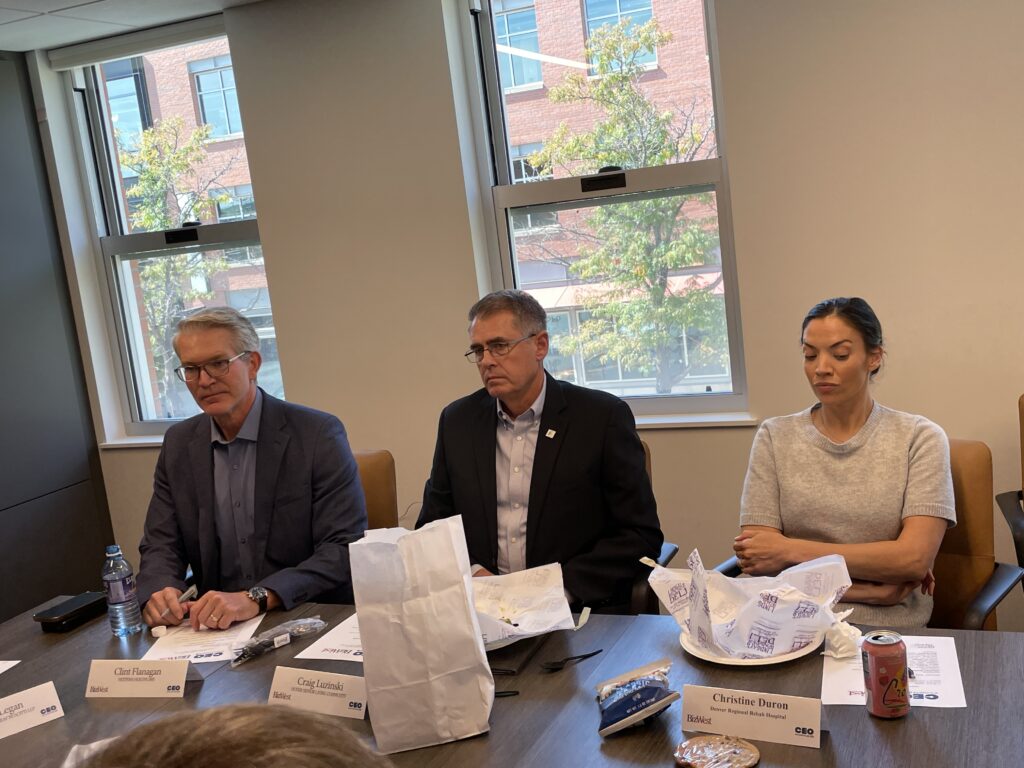
Denver Regional Rehabilitation Hospital has opened a 31-bed rehab facility in Thornton and just broke ground on a 56-bed center in Broomfield. Its CEO, Christine Duron, noted that “we just got a 2% decrease in per diem rates, so we’re trying to manage the loss of coverage for Medicaid patients. Medicare Advantage will give you authorization, then say they overpaid a year later and try to take it back.
“Medicare is our highest reimburser,” she said, and “commercial payers aren’t much better than Medicaid.”
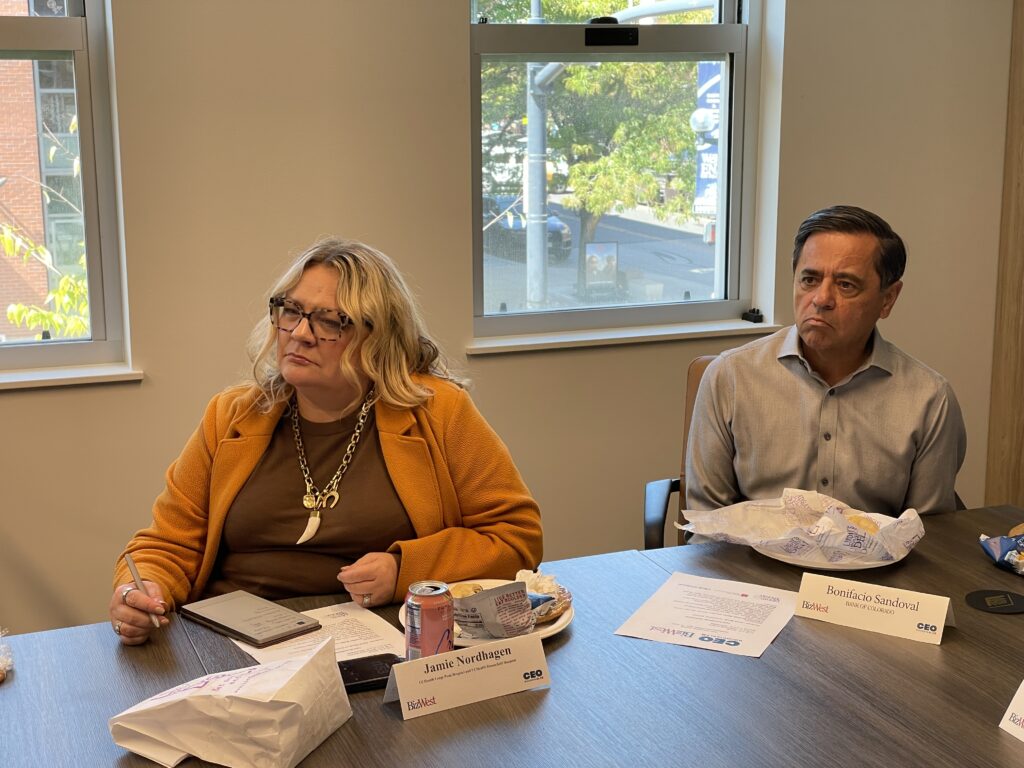
Jamie Nordhagen, chief nursing officer at UCHealth’s Broomfield Hospital and Longs Peak Hospital in Longmont, added that “we see coverage lapsing for folks related to the One Big Beautiful Bill, and things like that are going to continue to get worse, which just makes operations challenging.”
At the Hover Senior Living Community in Longmont, CEO Craig Luzinski also is feeling the pinch from the Medicaid issues.
“A lot of our seniors have just run out of money,” he said. “Their funds that they’ve had put away for many years are not enough to extend them when they get into their 90s and 100s. So then they have to go on Medicaid, whether it’s managed Medicaid for assisted living or straight Medicaid and long-term care. So then our reimbursement goes to less than half of what we would get if we had private pay.
“We’re trying to manage that,” he said. “We want to be a provider of Medicaid and help the lower income, but yet we have to balance our budget as well. After many years of saying once people enter Hover they can stay in Hover the rest of their life, that’s not the case anymore. We have to look at where else can we work with some of our partners to place people.”
Duron agreed that “it’s a delicate balance.
“We’re lucky because we’re in a post-acute space. We don’t have an ER; you can’t just walk in. We get referrals. We don’t accept any unfunded patients, but we have a lot of underfunded patients with Medicaid,” she said. “We do our best. We stay about 35% to 40% Medicaid because that’s what the population is, but in order to offset that, we do have to rely on Medicare, which is our highest-reimbursement payer. So it’s a delicate balance of toeing the line of how can we make this work. The cost of the patient on Medicare, despite their insurance, is the same, but the reimbursement is so much less for Medicaid.
“You have to look at your payer mix and keep it as close to your budget as you can.”
At the Hover community, Luzinski said, “we’re in somewhat of the same boat in that we don’t have an emergency room. We have a balance in the post-acute. We could fill up instantly with Medicaid, but that would not be good financially. Most of our people on long-term care are self-pay. We run financials on them to make sure they have at least three years of financials, but their life expectancy is above that in most cases.
“Our assisted-living part is probably the same, around 90% self-pay,” he said. “If we can’t get the money from government sources, we have to increase the self-pay. And what we find is that in the post-acute space, we can easily outpace ourselves in the market. Then we see people staying at home longer, which is a post-COVID type thing. Because of the amount of home care available, they’re able to stay home longer. But when they come to us, they’re much sicker.”
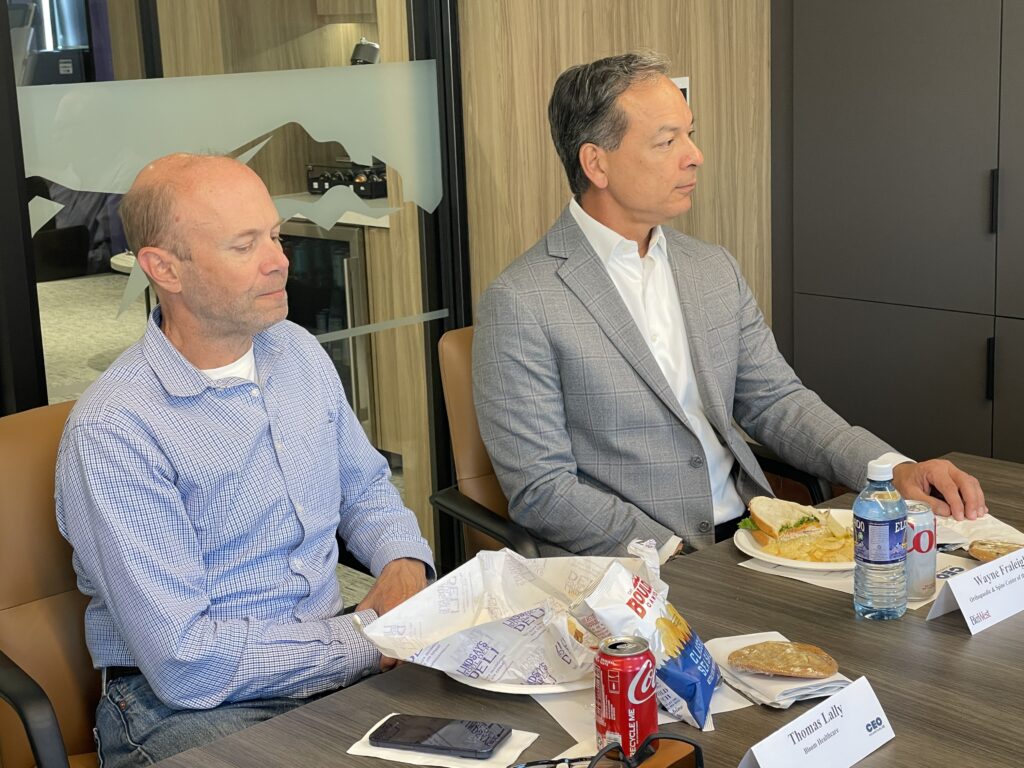
Those rising costs mean some people are putting off getting needed care, said Lexi Bambas Nolen, executive director of Boulder County Public Health, and Wayne Fraleigh, CEO of Orthopedic and Spine Center of the Rockies.
“I see public health as kind of a bridged space between healthcare and the business community because there’s such a strong relationship,” Nolen said.
Because patients are paying more out of pocket, “they want care how they want it, when they want it, where they want it,” Fraleigh said. “As we continue to grow in this consumer type of market, we’ve got to figure out ways to help meet those needs but still have the physician help determine that plan of care for patients. Our government payers are making that challenging, and patients are holding off on getting some procedures.”
Nolen added that “what impacts the healthcare system affects public health, and if costs get too expensive and people make different decisions about what their financial priorities are, it affects public health,” she warned the other healthcare executives. “When the federal government makes decisions about what the immunization schedule should be or what kinds of funds they’re providing for youth mental health, it affects you all.”
Rising costs also mean “we’re seeing folks get into healthcare out of necessity,” Nordhagen said, and that affects hiring. “That changes the workforce and what they’re looking for, so we’re having to be really agile in a space where folks are really mobile.
“We don’t have enough nursing schools to provide the workforce we need from an RN perspective, so we have to back the train up and look at how we’re getting folks into nursing schools and through nursing schools with our aging population.”
She said one of her UCHealth hospitals’ most urgent needs is people to work in “imaging, from radiologists all the way to techs, and registered nurses.
“It’s more challenging now than it’s traditionally been,” she said. “We need to continue to partner with higher education on how we’re creating nurses. Folks are going into healthcare because that’s where the jobs are, but it’s going to be up to us to leverage and build the skill sets.”
Adult apprenticeship programs can help with that, said Matt Wiggins, associate vice president for economic vitality at the Boulder Chamber.
“We partner with specific employers,” he said, “and we build out competencies in specific occupations.” If healthcare employers say they need more certified nurse assistants, for example, “we’ll start working with our institutions of education to build out adult apprenticeship programs.
“What that means,” Wiggins said, “is that for every apprentice that an employer has, tax credits range around $12,000 per year, and you can have up to 10 apprentices. So do the math; it’s up to $120,000 in tax incentives for an apprenticeship program at your location.”
At Bloom Healthcare, Lally agreed, “we don’t have the workforce to be able to match the demand,” and Luzinski said at Hover, “we don’t have a real big problem hiring; it’s retention, and then with retention comes more money put into training.”
To cut costs, Fraleigh said, he’s asking “how do we look at using our workforce differently, and part of that is how do we utilize technology,” including using artificial intelligence to free up telephone operators.
“Can we use those people in different ways to help optimize patient care? How do we use AI to help improve access on the front end for scheduling, so that they’re actually able to get something scheduled day or night at times that work best for them? How do we utilize AI to help our physicians get through their documentation so that after an 8- or 9-hour day of patients or being in surgery that they don’t have to now spend two or three hours to document their notes?
“To do that, you have to get a medical-records system that allows you to do it,” he said, “but those aren’t cheap.”
Technology can also aid preventive healthcare as well, Nordhagen said, including “putting a wearable on someone when they come into the emergency department, send them home and then monitor them from a virtual health center, and then ensure that they have timely access in a day or two or three where someone’s checking in on them, instead of a high-cost hospital bed that maybe someone sicker needs.”
Public-health agencies are on the front lines of the affordability crunch, Nolen said.

“We don’t have a lot of ways to self-fund or to diversify our funding streams and apply to a different vendor,” she said. “We’re all competing for the same funds. A lot of our philanthropic donors that historically have funded public health are saying, ‘We’re shifting our focus because the Medicaid vacuum needs the money right now.’
“In times of very restricted resources, we’re having to make choices between communities’ immediate, urgent healthcare needs and longer-term investments in what would contribute to healthy aging or lower ER visits or fewer adverse childhood events,” she said. “Those are harder arguments to make.”
Dr. Clint Flanagan, CEO of KerixHealth, an organization that rebranded from Nextera Healthcare in August 2025, is high on his organization’s business model as an alternative.
“It’s a direct primary-care business paid mostly by the member or the employer, like a gym membership,” he said.
“Are employers paying us less? Yes. But at the end of the day, we’re all payers. We’re either a patient paying for something or we’re taxpayers. While Blue Cross, United, Cigna and Anthem call themselves payers, it’s not their money, it’s your money. Medicare and Medicaid is our money, too.”
As an alternative to traditional fee-for-service, insurance-based primary care, he said, “direct primary care is the fastest growing service. We’re opening new clinics and telling doctors, ‘We’re not going to judge you on quantity any more. We’re going to judge you on quality.’
“In a fee-for-service, insurance-based model, they feel hurried or rushed,” Flanagan said. “They have to see 20 or 30 patients a day to generate the revenue that you want to generate. There’s not a primary-care doctor in the world who wants to do that.’
“So we rescue these docs, bring them into our model. We tell them your patients are going to be able to see you face to face, if a patient has an urgent issue, we guarantee a same-day visit for urgent-care needs. And that is not just 8 to 5; it’s virtually after 5 p.m.
“That continuity and the relationship and the trust is paramount,” he said. “Primary care and fees for service destroyed that. So we’re just restoring that, but doing so in a business model where it’s fixed revenue.”
To create more affordability, Nordhagen said, “for me, it’s the right care in the right place at the right time with the right people. We’re seeing the emergency department becoming the front door for folks who don’t have coverage, and that affects access to care for everyone. And we’re seeing that. We’re full.”
So are we, said Vissers.
“Right now we’re busting at the seams at BCH,” he said. “We were originally looking at significant expansion of the hospital, but we’ve scaled that back. We’re taking those resources to make our hospital more efficient and more patient-friendly and move patients through more safely, quickly and effectively. But we’re not adding that many more beds. What we are doing is taking those dollars and investing them in the communities we serve.
“While we are Boulder-based, more of our growth is all coming from the surrounding area,” he said. “So we believe that our dollars are best invested in moving the care to where the patients live – and also moving the care to where the workforce is. So the majority of our investment over the next few years, which is a lot quicker than building another hospital, is going to be in adding primary care, specialty care, imaging labs, surgery centers – in Longmont, Lafayette, Superior, Erie, all these places where people are having to drive to come to us.
“We estimate that about a third of the cases we’re doing at the hospital, we could do at a surgery center in Erie or Lafayette or you name it.
“Recently Boulder came up as one of the top five areas of the country for access to healthcare, which is really excellent. We’re very proud of that,” Vissers said, “but I think a subset of that is making sure that that excess is equitable. Some of those reimbursement challenges make that even more difficult, so we’re going to see greater challenges going forward as some of the impact of the One Big Beautiful Bill Act starts to hit.”
The key, he said, is generating more ideas.
“The other part of affordability is keeping people out of the hospital and keeping them out of the surgery center,” Vissers said. “Our board has pushed us toward a healthy-aging initiative. Every few years in our strategic plan, we say, “What can we do to give back to the community?’ What we heard loud and clear is that we really need to be focusing on aging. When I talk about aging, it’s not just geriatrics, palliative care or end-of-life care. It’s what difference I can make when you’re 50 or 40 or 30 so that, 20 years down the road, you don’t actually need our hospital services.
“So despite all the doom and gloom and the challenges,” he said, “I’m actually excited for this next phase of healthcare, and I think it’s pushing us toward a greater degree of responsibility and thoughtfulness around what is affordable for a health system, a patient and a community to achieve better care.
“That’s our plan,” he said. “We’ll let you know how it works out.”
Also attending the Roundtable were Aaron Spear and Bonifacio “Boni” Sandoval of event host Bank of Colorado and Ashley Legan of event sponsor Berg Hill Greenleaf Ruscitti. Accounting firm Plante Moran also sponsored the event.
Finding and keeping their workforces are a continuing struggle for Boulder Valley healthcare executives who attended a BizWest CEO Roundtable last week, but most also said federal cuts to Medicaid reimbursements included in last year’s “One Big Beautiful Bill Act” are causing the deepest concern, both for the institutions and their patients.

Related Posts
-
Budget and staffing cuts implemented by the Trump administration could have a profound effect on…
-
As 2025 draws to a close, nonprofit groups across the Boulder Valley and Northern Colorado…
-

BOULDER — Cultivate, a Boulder nonprofit group that supports seniors, faces funding reductions from Boulder…
-

As the end of 2025 approaches, nonprofits in Northern Colorado face some tough financial challenges,…
