
Exploit Boulder’s quantum advantage, execs told
Race for technology supremacy called ‘very real’

BOULDER — With all the current buzz about quantum computing around the Boulder Valley, it may be hard to believe that the theory behind it is a century old.
But it is.
And executives attending a BizWest CEO Roundtable on cutting-edge technology at Google Boulder last week got some century-old advice about how to keep Boulder the epicenter of quantum innovation.
Scott Sternberg, executive director of the University of Colorado Boulder’s CUbit Quantum Initiative, recalled pioneering automaker Henry Ford’s admonition that “the person who stops advertising to save money is the person who stops a clock to save time.”
The region, said Alison Karp, senior program manager for the Colorado Quantum Fund at the state Office of Economic Development and International Trade, “has the highest concentration of quantum workers, quantum companies, I believe, in the world. We do have an ecosystem here that we want to be sharing.”
The Boulder Valley — with its powerhouse federal labs and CU’s world-class physics department — has become, over the past few decades, a global epicenter for quantum research. That’s why the U.S. Department of Commerce’s Tech Hub program last year granted Elevate Quantum, a nonprofit consortium of about 70 stakeholders who represent industry, academia, capital and laboratories in Colorado and New Mexico, a Phase 2 Tech Hub designation that unlocked $127 million in state and federal funds, which are expected to generate several billion more dollars of private investment in the region’s quantum industry.
Quantum theory attempts to explain the behavior of matter at atomic and subatomic levels. Because quantum computers take advantage of special properties of quantum systems such as superposition, their computing power and speed is exponentially greater than a traditional computer. Applications of quantum science could revolutionize the way humans discover new drug therapies, map the cosmos, protect sensitive data, combat climate change and maybe even discover new forms of life in deep space.
Sternberg reminded the group that 2025 has been declared the 2025 International Year of Quantum Science and Technology because it’s been 100 years since the initial development of quantum mechanics.
“So why am I hearing so much about quantum now? We’ve now gotten to the point where we can engineer products and systems to exploit some of the most difficult principles of quantum that have been brewing over the past 100 years,” Sternberg said. “That’s why we are here. We look at other economies around the country and around the world, and they don’t have that legacy of 60-plus years, over a half a century, of working in this space. They don’t have the four Nobel Prizes. They don’t have the 3,000 workers. They don’t have the 50-plus companies. That we have here” in the Boulder Valley.
“That puts us in such a unique position,” he said, because “the family tree (of quantum research) that started in Boulder is now everywhere in the world.”
An innovative atmosphere
That innovative atmosphere extends beyond quantum to other areas of technology and helped lure Google to Boulder, noted Kieran Casey, managing director of gTech or Google Technical Services. That global support and operations team within Google is focused on providing technical expertise and solutions to Google’s customers and users.
Of the approximately 1,800 Google employees in Boulder, she said, gTech’s 350 makes it the third-largest presence in the Boulder office.
“We are a net importer from other offices within Google,” Casey said. “This is a destination they want to work in. Overall, Google is a destination employer and I think we were very fortunate that we were able to get the company to come here.”
But just as quantum theory is nothing new, neither are the challenges the Boulder Valley faces in maintaining its position atop the quantum — and technology — world. One of them is the cost of housing.
Sternberg, who arrived in the area four decades ago, noted that “Boulder has always been incrementally more expensive than anywhere else in the state. Let’s not say ‘Oh, my God, all of a sudden Boulder costs a lot.’ It’s always been the case.”
That doesn’t mean those costs aren’t still a problem, acknowledged Joe Hovancak, executive director of the Boulder Chamber Economic Council.
“We’re at a tipping point with the headwinds of housing affordability, transportation and reducing homelessness,” he said. “We took a gut punch when COVID came around and with Techstars leaving. There was industry reverberation.
“Because it’s not as affordable, convenings are not happening in Boulder,” he said. “They’re spread out to Longmont, Louisville, Superior, Denver. But there is a momentum that’s building. When I talked to Techstars earlier this year, they were thinking about Chicago, Atlanta, Silicon (Valley), I said, ‘No way!’ We’ll get behind it. And now they’re coming here.”
Hovancak’s persuasion has been pretty basic, he said.
“I’ve just said by the way, Phoenix’s too hot, Silicon’s too expensive, Boulder’s great. We want you here.”
With all those headwinds, Sternberg asked, “why do we have the high-tech industry here? Why do we have aerospace? Why do we have bioscience? Why do we have outdoor products? Why do we have the natural-foods movement? Because people want to be here. They don’t view it as a cost. They view it as an investment.”
One who made that investment in Boulder was George Douaire, CEO of StrideTech, which produces attachments that help prevent falls by seniors using walkers to aid their mobility. The founding team used resources from CU Boulder, including Catalyze CU and the New Venture Challenge, to develop their technology and business concepts. By early 2021, they had completed a six-week beta test with residents at a local senior living community.
“I’ve been here five years now,” Douaire said. “I came here from Chicago, where I spent most of my career. The thing that I love about Boulder is how small it is. You can find anybody and everybody, even up to the governor’s office, which is fantastic.”
When he had to work with a state agency, he said, “I called and somebody answered the phone! And she called back twice to make sure everything was done properly. I realized the state of Colorado is half the size of Cook County, so there’s a little more ease in that.
“And you have this community that’s filled with entrepreneurs and investors,” he added, noting that most of their focus is on high-dollar projects.
“When I wanted to raise $250,000, my God, was that hard,” he said. “I’ve raised hundreds of millions of dollars for other companies and other things I’ve been involved with, but the check size was too small. It wasn’t of interest.”
Peter Adams, managing partner of the Rockies Venture Club, said part of that problem may lie with the explosion of the artificial-intelligence industry. “AI is sucking all the air out of the room for funding,” he said.
And yet AI provides “a lot of opportunity for research and development,” said Dede Willis, president and CEO of Orbit Genomics. “AI is the only way we can understand the complex data that we have, including quantum as we expand.”
When Levin Sliker co-founded Point Designs, a Broomfield-based company that makes heavy-duty prosthetic fingers, he said his team shunned venture-capital funding and instead bootstrapped the company with help from Small Business Innovation Research and Small Business Technology Transfer grants. Those federal government programs provide non-dilutive, early-stage funding to small businesses for research and development with commercialization potential.
However, Brynmor Rees, assistant vice chancellor for research and innovation for Venture Partners at CU Boulder, noted that there could be a “major threat from the delayed impact of federal funding cuts, especially involving those SBIR and STTR grants.
“Those early-stage discoveries aren’t going to happen,” he said, “and they won’t translate into the companies that are going out and getting SBIR, STTR going through. There will be this coming impact if we cut out the foundational support.”
Added Stan Hickory, director of innovation and entrepreneurship at CU New Venture Challenge, “We know the cut in funding is going to impact research here.” However, he said, that threat prompted a change in approach.
“One of the things we’re doing here at CU is focusing on those industry partnerships to bring in funding where it’s ‘problem statements’ as opposed to a researcher that’s really excited about some kind of research but commercialization of that might not be a pathway. We’re flipping that model and saying these are the things we need solutions to and the researchers jump on that because that’s where the funding is.
“Maybe across the country, that’s going to lead to an exponential explosion of commercialization and problem-solving opportunities,” Hickory said. “Maybe that’s the silver lining in the situation we’re in.”
As Sternberg noted in February at a Longmont Economic Development Partnership summit, the university’s $750 million in federal funding is “under threat right now. For us to advance as a university, a municipality, a country, we need political certainty.”
However, he said then, he remains “pretty bullish” about the industry’s growth in the region, especially because, “in places like Boulder, you can’t hit a 9-iron without hitting a quantum scientist.”
At last week’s roundtable, Rees admitted that the venture market is challenging” but added that “Colorado is still doing really well, even in competition with such technology magnets as New York, Boston, Southern California and the San Francisco Bay area.
“They’re sizably ahead of anywhere else,” Rees said. “But that next tier is Seattle, Austin and Boulder. Last quarter, we had a little under 100 deals valued at a little under $2 billion. So it’s still strong here. And the university is a big part of that.”
Sternberg said CU has built its quantum focus on “three very distinct pillars: discover, educate and commercialize. At the university, clearly our research and development efforts are under strain right now in this political climate. But continuing the innovation engine, which is the fundamental research and development structure for us, is a key priority.
“If you don’t have those three pillars, you don’t have a viable market or industry sector,” he said. “We are so lucky that in Colorado broadly and here in Boulder, and across all of our industries, we have all three of those pillars.
“That is what we’re standing on,” Sternberg said. “We have the capability, so we have the responsibility to perform – not just at the state or national level but at the international level.”
Karp noted that OEDIT is supporting opportunities created by last year’s passage of House Bill 1325, which established a framework for tax credits aimed at supporting the quantum technology sector in Colorado. The legislation permits the issuance of tax-credit certificates for registered loans issued to companies heavily relying on quantum technology.”
Part of that effort is a quantum incubator, she said. The Colorado Quantum Fund for Innovative Lending, enacted as part of the legislation, improves access to capital for quantum companies in Colorado by encouraging lenders to make favorable loans to companies by registering up to 15% of the loan in a pooled loan loss reserve. The reserve is accessible with a 100% refundable tax credit should the lender incur losses associated with those loans.
Applications are currently open for lenders who complete a lender verification process. The total tax credit allocation will begin on a first-come, first-serve basis.
“We’re hoping to educate national lenders about quantum,” she said, “and educate quantum companies about the power of debt and really utilize it in a way to grow their companies.”
Noted Sternberg, “We are so blessed to have a governor who gets this, and the governor before him, and the governor before him.
“The future of quantum is here,” he said. “The rumor that it’s going to be five, 10, 15 years in the future is absolutely incorrect. It is here, it’s active. It’s here in Boulder. More broadly, it’s here in Colorado, and more broadly still it’s here in the intermountain West.
“The race to quantum supremacy is very real.”
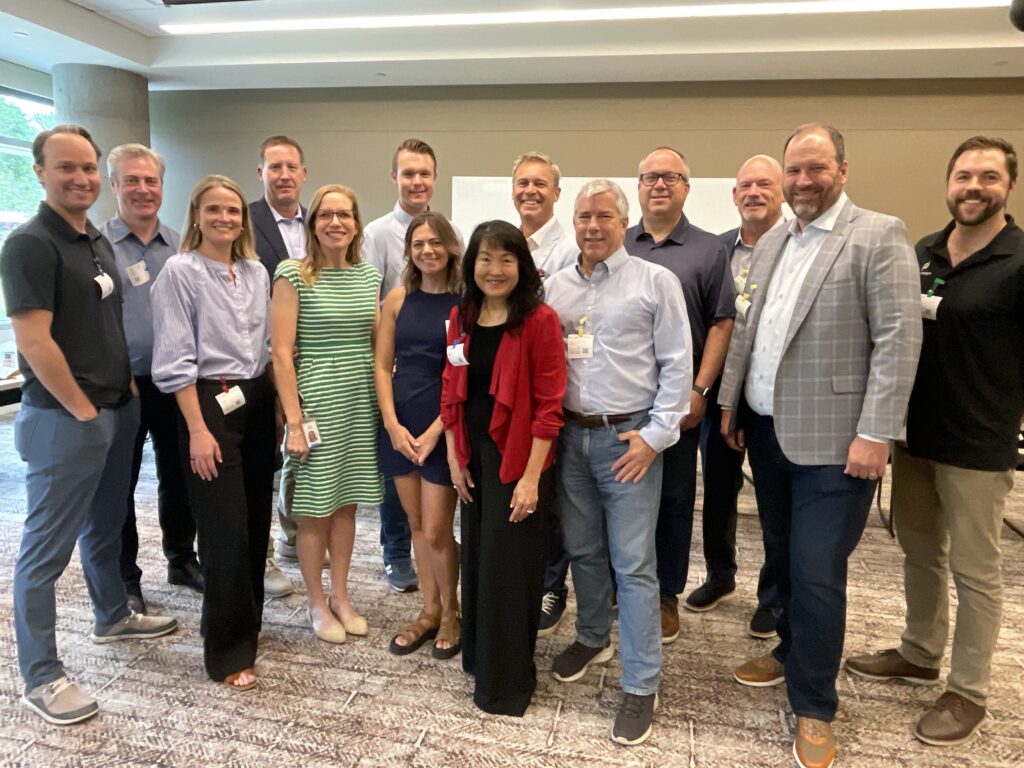
Attending the CEO Roundtable were sponsors Jeremy Wilson and Sean Nohavec of Plante Moran, Aaron Spear of Bank of Colorado, and Ashley Legan and Jared Crain of Berg Hill Greenleaf Ruscitti LLP.
Executives attending a BizWest CEO Roundtable on cutting-edge technology at Google Boulder last week got some century-old advice about how to keep Boulder the epicenter of quantum innovation.
Related Posts
-

Infleqtion, a quantum information company, was recently awarded $11 million from the U.S. Department of…
-

Infleqtion Inc. recorded $9.5 million in revenue during the first quarter of fiscal 2026, a…
-

The Boulder Valley’s already robust quantum technology ecosystem has a high-profile new player: Google.
-
Infleqtion Inc. says it has inked a deal with the U.S. Department of Commerce’s CHIPS…
