
Confluence: Cities, developers work to mitigate high water costs
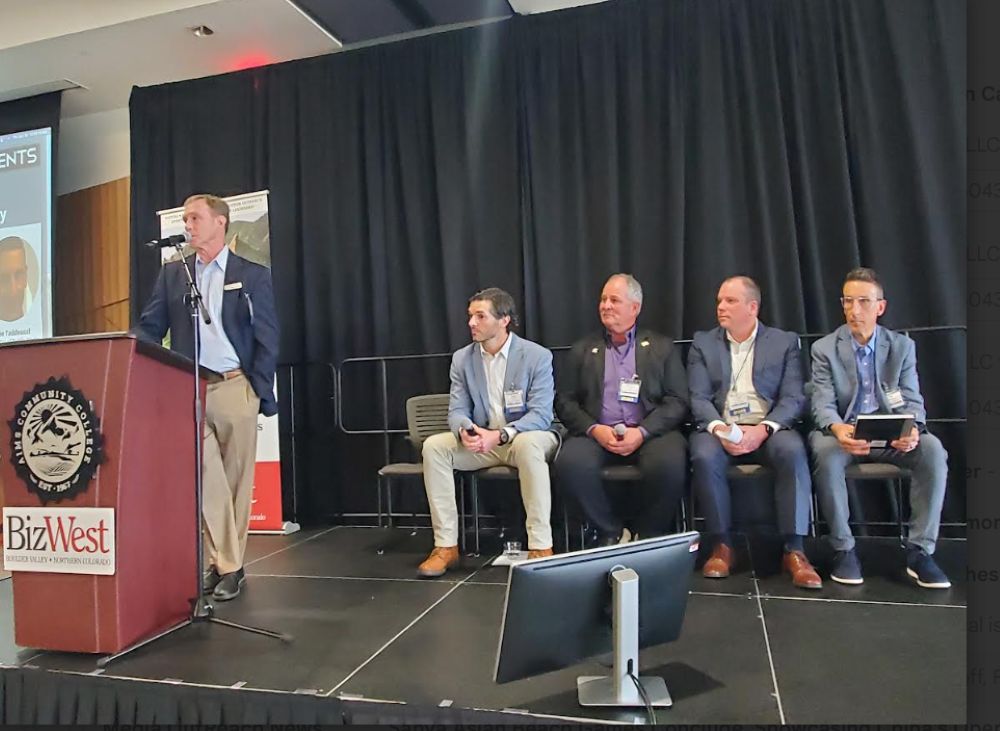
GREELEY — As Northern Colorado adds residents and industry, municipalities and developers have to find ways to mitigate the state’s high water costs, panelists at a BizWest Confluence event said last week in Greeley.
Colorado has “seen some of the highest overall water prices in the West in the last 10 to 20 years,” said Todd Gaston, senior associate and economics lead at Boise, Idaho-based consultant WestWater Research. Among western states, he said, “Colorado is No. 2 in total value traded in the last 10 years and No. 6 in total volume traded. What that’s indicating is that your price per unit is the highest.”
And that price keeps going up, Gaston said, with average water bills outpacing inflation in the last 10 years. The average increases during that period have been 7% each year, compared with slightly more than 4% average gains in the Consumer Price Index.
Gaston aggregated nine Northern Colorado water providers and compared them with similar-sized markets. He found that they charge an average of $91,000 per acre foot as opposed to $20,000 in Goodyear, Arizona, and $6,000 in Bozeman, Montana.
“If you look at the Excel spreadsheet of any builder’s costs, water is going to be the No. 1 cost,” said developer Martin Lind, owner and CEO of the Windsor-based Water Valley Co. “It’s more than concrete, it’s more than wood. It doesn’t have a disparity between a million-dollar home or a $200,000 home; it’s the same cost.
“The cost of water is the giant inhibitor to affordability in Colorado,” Lind said. “But we live in a desert. That’s where we’re at in Colorado.”
Cost is just one of the challenges facing two very different cities in Northern Colorado: Boulder and Greeley.
Boulder’s water utility serves a population of about 100,000, said Joe Taddeucci, its public works director. “Our biggest challenge, given that we’re an old city, is aging infrastructure and keeping up with that and replacing it.
“We have some key components in our water system that are still over 100 years old, and we’ve been working furiously to replace those,” Taddeucci said. “At our wastewater plant, there are regulatory upgrades that come our way and we just have to meet those. We have to fund major capital projects to be able to comply with new regulations. Modern floodplain regulations came into play in the 1970s, and we’ve been forever since trying to retrofit an older city to those modern floodplain regulations.
“All of those things combined accumulate a number of major capital projects,” he said, “and we have a backlog in each one of the three utilities” — water, sewer and stormwater.”
Since the era of the COVID-19 pandemic, he said, “cost escalation is hitting all of those projects. You might have had a $20 million project 10 years ago, and that same identical project now might be $30 million at minimum, with no changes. Some of these big projects take a long time to develop because of the permitting and all of the approvals that you have to go through. So all of those factors create a set of challenges and tight budgets and project-timing decisions that we have to work with.”
While Boulder’s growth is restricted by mountains to the west and open space to the east, Greeley does have room to expand, said Virgil Pierce, that city’s utility and finance manager. With an abundance of water rights, he said, “we rent to ag, we rent to oil producers. That’s one of the revenue streams that comes back and offsets some of those costs.”
Citing Greeley’s “enormous water portfolio,” Lind noted, “they can control their destiny. They can use it as an incentive tool to compete with anybody on the Front Range. So we see Greeley as one of the really bright spots with that last 100 years of planning,”
That doesn’t mean the Weld County seat doesn’t have its own set of challenges in dealing with high water costs.
“We’re waiting for the growth to come that is supposed to be paying for it,” Pierce said. “If you build infrastructure for expansion ahead of time but the growth doesn’t happen that we were planning on happening, we have to go back to our customers and tell them there’s a greater rate increase than we were hoping.
“At the same time, if we postpone some replacement projects, we’re taking the risk that that asset will continue to function without failing.”
Taddeucci agreed.
“We can’t defer maintenance too long and let things pile up,” he said. “We try to focus our dollars where the biggest risk is.”
For Boulder’s water consumers, he said, his mission is to “keep our prices affordable and predictable. We try for moderate, steady rate increases so we avoid whiplash for our customers.”
Regulations and technology have helped mitigate some consumer costs, Lind said.
“One of our subdivisions we built in 2002, it uses 15% more water than our 2018-2025 subdivisions,” he said. “Low-flow toilets, low-flow showerheads. That side of the regulation of the industry is helping on the actual flow.
“But we’ve got to figure out how to build a smart home with water, and I don’t know if that means recycled or regenerated water.”
Lind’s background in farming helped his Water Valley Co. make some smart choices.
“The land we bought from Kodak back in 1990 was very rich with historical, very valuable water rights,” he said. “Growing up in agriculture, we did not want to lose that. So we came up with a way to aerate the lawns; anything green comes out of what we call corn water. and potable water is only served inside the house.
“We’ve got over 6,000 residents on that system right now and it’s working really well, with tremendous savings on the monthly fees.
“But that does not help with the actual appropriation when it comes to building the initial home,” Lind said. “So that burden to the builder or developer ends up being a burden to the consumer at the end of the day. There’s absolutely no way around it.”
For cities as well as developers, Lind said, conservation is the key to keeping costs down.
“We talk about the opportunity to build smart cities electronically,” he said. “We’re going to have to look at building smart cities waterwise. We’re going to have to look at more efficient flows.”
As Northern Colorado adds residents and industry, municipalities and developers have to find ways to mitigate the state’s high water costs, panelists at a BizWest Confluence event said last week in Greeley.

Related Posts
-
Time is running out to register for the 18th annual Boulder Valley Real Estate Conference,…
-

Erickson Realty in Fort Collins has rebranded as Enjoy Realty LLC.
-

he Group Inc. Real Estate LLC has opened a new Windsor office at 517 Main…
-
Real estate professionals are eligible to earn seven continuing-education credits at the 18th annual Boulder…
